December is the longest month on a kindergarten calendar and the shortest month in a kindergarten classroom. There are four weeks to fill, and every one of them is broken up by something: a holiday concert rehearsal, a class party, an assembly, an early dismissal, a child who is already counting the days to break. The math and literacy skills still need teaching, but the children are excited, the schedule is full, and a lesson that would take twenty minutes in October takes thirty in December. This guide is a plan for all four weeks: December activities for kindergarten that keep the learning going without fighting the season. Each week has math, literacy, a craft and a read-aloud, and every idea works on its own. Where one of our printable resources fits a step, we point to it.
What to Teach in December, and Why
December is not a month to start something new. It is a month to practice what children already know, in a new shape. The skills that matter most for kindergarten in December are the ones from the fall: letter sounds, heart words, counting to 20 and beyond, number bonds to 5 and 10, and writing a simple sentence. A Christmas or winter theme gives those skills a reason to be practiced again, and children who would groan at a plain worksheet will happily count ornaments, trace the letters in "snowman" and write about what they want for the holidays.
The second thing December teaches is the calendar itself. Young children do not really understand how long a month is, or what "next week" means. A December calendar on the wall, with a paper chain or a countdown, turns time into something they can see. Count the days together every morning. Mark the concert, the party and the last day. By the third week, children will be counting on their own, and that is real math.
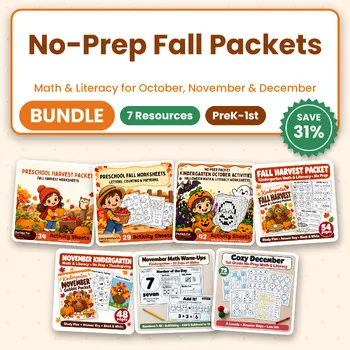
The third thread is winter holidays. Many families celebrate Christmas, some celebrate Hanukkah, some celebrate Kwanzaa, and some do not celebrate any of them. A kindergarten classroom can hold all of that, if the teaching stays simple and respectful: these are holidays some families celebrate in December, here is what each one looks like, and here is what our class is doing together. The Kindergarten December Activities Packet is built around exactly this shape, with Christmas math and literacy practice in two levels, a four-week plan, writing prompts and a gingerbread craft, so the month has a spine even when the days are chopped up.
Week 1: December Begins
The first week of December is the calmest week of the month, so use it. This is the week to teach the routines you will repeat for the next three weeks, and the week to start the projects that take time.
Math: Start the countdown. Put up a paper chain with one link for each school day left in December, and take one off every morning. Count the links that are left, count the links you have taken off, and ask which number is bigger. Count ornaments as you decorate: how many red, how many gold, how many in all. Play a simple game with two dice: roll, add, and cover that number on a ten-frame board. The numbers stay small, the game stays fast, and children get real addition practice without sitting still for long.
Literacy: Start the heart words. December is a good month to begin a heart word routine, because the words appear everywhere: "the," "said," "come," "they," "was." Put up a word wall, add two words a week, and practice them every morning with a quick chant or a clap. The Kindergarten Heart Words Worksheets teach 60 kindergarten heart words over 10 weeks, with color by code mystery pictures, two levels, word cards and a progress tracker, so the routine you start in Week 1 can run all the way into spring.
Craft: Make the paper chain, and make a class snowman. Cut a large snowman shape from white paper, and let each child add one thing: a button, a carrot nose, a hat, a scarf. The snowman goes on the wall and stays there all month, and children can point to the part they added. It is a craft and a community builder at the same time.
Read-aloud: Read a winter book every day this week, one a day, from the library. After each one, ask one question with an answer in the book and one question about what the children think. The discussion is the comprehension work at this age, so keep the questions oral and let every child answer.
Writing: Start a December journal. One sentence a day, with a drawing. "Today it is cold." "I saw a snowman." "My favorite color is red." The drawing carries the meaning; the sentence is one real sentence, and that is enough. The Kindergarten December Activities Packet has writing prompts that fit this routine, so the journal has a fresh prompt every day instead of the same one.
Week 2: Winter Holidays Around the World
The second week is the week to teach about the holidays themselves, because the children are already talking about them. Keep it simple, keep it respectful, and keep it about what families do, not about what families believe.
Math: Keep the countdown going, and add a sorting game. Sort ornaments or counters by color and size, sort picture cards of holiday foods, sort winter clothes into things you wear outside and things you wear inside. Sorting is real math, and it works as a center while you read with a small group. Count by 5s and 10s with the paper chain: five links, ten links, fifteen links. The chain makes skip counting visible.
Literacy: Teach the holiday words. Christmas, Hanukkah, Kwanzaa, menorah, candle, gift, family. Say each word, clap the syllables, find the first letter. Read a simple book about each holiday, one a day, and talk about what is the same and what is different: all three holidays involve lights, family and giving, and that is a lot for a five-year-old to notice. The Kindergarten Winter Holidays No Prep packet covers Christmas, Hanukkah and Kwanzaa math and literacy worksheets in two levels, with a four-week plan and answer keys, so the same holiday can be taught at two levels in one classroom.
Craft: Make a paper menorah, a paper kinara or a paper tree, depending on what your class is learning about that day. The point is not the product; it is the conversation while children are making it. Ask what their family does in December, and let every answer be welcome. If a child says their family does not celebrate any of these holidays, that is a teaching moment, not a problem: ask what their family does do in December, and add that to the chart.
Read-aloud: One holiday book a day, and one retell. After the book, three picture cards (beginning, middle, end) that children put in order and describe to a partner. If a child can retell the story in order, they understood it.
Writing: Write a holiday card. Every child makes one card for someone in their family, with a drawing and a sentence: "I love you." "Thank you for the cookies." "Merry Christmas." The card goes home, which makes the writing matter in a way a worksheet never does.
Week 3: The Week Before Break
The third week is the hardest week of the month. The concert is this week or last week, the party is coming, and the children can feel the break. Short activities work better than long lessons. Set up centers, ten minutes each, and rotate.
Math: Four centers, ten minutes each. At the first center, children count and sort: ornaments, buttons or linking cubes in winter colors, sorted into ten-frames or counted in groups of five and ten. At the second center, they play the dice addition game from Week 1, with a winter board. At the third center, they build patterns with paper snowflakes, paper chains or colored counters: red, white, red, white, what comes next. At the fourth center, they work on number bonds to 5 and 10 with winter pictures. The Kindergarten December Activities Packet has Christmas math practice in two levels, so the same center works for a child still learning to count to 10 and a child ready for more.
Literacy: Keep the heart word routine going, and add a new one: a winter word hunt. Hide winter words around the room (snow, cold, ice, gift, star, tree) and let children find them, read them and copy them into their journals. The Kindergarten Heart Words Worksheets fit here as a quiet center: color by code mystery pictures that only appear when the words are right, which means children check their own work as they go.
Craft: This is the week for the snow globe. Every child makes one, and every globe is different. The Build a Snow Globe Craft has winter, Christmas and Three Kings Day globes with writing at three levels, so a Pre-K child and a 1st grader can sit at the same table and both be working at the right level. The writing is the point: a sentence or two about what is inside the globe, and why the child chose it. The globes go home, and they are the craft most likely to end up on a shelf instead of in the bin.
Read-aloud: Read a gingerbread story, and then read a second version of the same story. Children love spotting what is the same and what is different, and comparing two versions of a story is real reading work. The gingerbread craft in the December packet goes with this read-aloud, so the story, the craft and the writing all land on the same day.
Writing: Write about the snow globe, and write a thank-you note. The thank-you note goes to a real person: a parent, a grandparent, a lunch worker, a bus driver. Give a sentence frame ("Dear ___, thank you for ___ because ___") and let children fill it in. The note goes home, and it matters.
Week 4: The Last Days
The fourth week is short, and that is fine. Most schools have a party, an early dismissal or both, and the children are past the point of new learning. The job this week is to close the month well: finish things, celebrate things and send things home.
Math: Finish the countdown. Take off the last links, count to zero, and talk about what comes next: January, winter, a new year. Play one last counting game with the ornaments, and let children take their paper chain home. A chain that took four weeks to build is a real achievement, and children should be proud of it.
Literacy: Finish the heart words for the month, and read the class book you have been building all December: the journals, the cards, the snow globe sentences. Read them aloud, one child at a time, and let the class applaud. For children who are ready for more, this is the week for the stretch option: the Cozy December 1st Grade Packet is a no prep 1st grade December packet with 19 math skills, 14 literacy skills, winter writing, a snowman craft, holiday cards and a four-week plan, and it works as 1st grade review or as a challenge for a kindergartener who is ready for harder work. Use it for the child, not for the whole class.
Craft: Finish the snow globes and the gingerbread craft, and let children take them home. The Build a Snow Globe Craft globes are the take-home that families keep, so give them time: a whole morning if you can, with the writing done first and the decorating after.
Read-aloud: Read the class favorite one more time, the book the children asked for again and again. Then read a New Year book, and talk about what a new year means: a new calendar, new seasons, new things to learn. Keep it short. The children are ready to go home.
Writing: One last journal sentence: "My favorite part of December was ___." Every child writes it, every child draws it, and the journals go home. That is the month, finished.
One Week at a Glance
If the four weeks above feel like too much to hold in your head, here is the shape of any single week in December. Monday: start the read-aloud and the math center, and put up the new heart words. Tuesday: literacy center and handwriting, five minutes with a purpose. Wednesday: craft day, with the writing done first. Thursday: family project or card, and the second math center. Friday: finish, share and celebrate, and take the countdown chain down one more link. The Kindergarten December Activities Packet follows the same weekly shape, with a four-week plan already written, so if you would rather not build the month from scratch, the plan is there.
Practical Tips for December
Teach all three holidays, or teach none of them. If you teach Christmas, teach Hanukkah and Kwanzaa too, in the same week, with the same respect. If your school does not teach holidays at all, teach winter: snow, ice, animals in winter, what we wear when it is cold. Either way works. What does not work is teaching one holiday as if it were the only one.
Plan for the assembly. Every December has an assembly, a concert rehearsal or a fire drill that eats forty minutes. Have the no-prep pages ready: the Kindergarten Winter Holidays No Prep packet and the December packet both have pages you can hand out with no preparation, so a lost forty minutes becomes quiet practice instead of lost time.
Keep the schedule visible. Excited children do better when they can see what is happening next. Write the day's plan on the board in three steps, and cross each one off as you finish it. The visual routine calms the room more than any reminder.
Send home what families will actually do. A snow globe, a card and a conversation are three things families finish. A packet of worksheets is not. Choose the take-home that fits your families, and keep it to one.
Watch the tired children. December is long, and the youngest children get tired first. If a child is melting down in Week 3, it is probably not the work. Give them a quiet corner, a book and five minutes. The work will wait.
Frequently Asked Questions
What December activities are best for kindergarten?
The ones that repeat a skill in a new shape: counting ornaments, tracing winter words, sorting holiday pictures, making a paper chain and reading one winter book a day. Kindergarteners learn December by doing it, so keep every activity under fifteen minutes and let them move between centers.
How do you teach Hanukkah and Kwanzaa in kindergarten?
Keep it to what families do: Hanukkah is a festival of lights celebrated with a menorah and candles, and Kwanzaa is celebrated from December 26 to January 1 with family, community and seven principles. Read one simple book about each holiday, make one simple craft, and talk about what is the same across all three December holidays: lights, family and giving.
What Christmas math activities work for kindergarten?
Counting ornaments into ten-frames, sorting by color and size, counting by 5s and 10s with the paper chain, simple addition with two dice, and patterns with snowflakes or paper chains. The numbers stay small, the games stay fast, and children get real practice without sitting still for long.
How do you plan four weeks of December activities?
One week at a time, with the same shape every week: a read-aloud a day, one math center, one literacy center, one craft and one short writing task. Start the routines in Week 1, teach the holidays in Week 2, run short centers in Week 3, and finish and celebrate in Week 4. A four-week plan with that shape survives assemblies, parties and early dismissals.
What can kindergarteners make for Christmas?
A paper chain, a class snowman, a snow globe, a holiday card and a gingerbread craft. Each one practices cutting, gluing or drawing, and each one gives the child something to show their family. The snow globe is the one they remember longest, because it has their own writing inside it.
How do you handle short days and assemblies in December?
Have no-prep pages ready before the month starts, and keep the schedule visible on the board. When forty minutes disappear, hand out the ready pages and let the children work quietly. A lost assembly slot becomes practice time instead of lost time, and nobody has to scramble.