Teaching Addition Fact Strategies in 1st Grade: From Counting On to Make a 10
A step-by-step guide to teaching seven addition strategies for facts within 20 in 1st grade, with a 3-week plan, games and differentiation tips.
Read the guide →Step-by-step plans, routines and ideas for the skills young learners practice every day, written by Activity Express.
A step-by-step guide to teaching seven addition strategies for facts within 20 in 1st grade, with a 3-week plan, games and differentiation tips.
Read the guide →A practical guide to teaching arrays, rows and columns, repeated addition and the commutative property in grades 2–3, with a 2-week plan and games.
Read the guide →A guide to teaching career exploration in grades 6–12 through high-interest nonfiction: interest inventories, skills, job ads, applications and projects.
Read the guide →How to use roll-and-read phonics game boards in K–2 to build automatic decoding, from short vowels to vowel teams, with plans, groups and checks.
Read the guide →A practical K–2 guide to weekly spelling and sight word practice: choosing lists, pretests, word work centers, choice boards, games and homework.
Read the guide →A practical fall guide to teaching repeating patterns in Pre-K–1st: finding the core, AB to ABC, fixing common mistakes and a two-week leaf plan.
Read the guide →Plan October, November and December math and literacy practice in PreK–1st with seasonal no-prep packets, warm-ups, centers and take-home work.
Read the guide →A week-by-week guide to December in 1st grade: which math and literacy skills to practice, how to use packets well, and how to keep routines calm.
Read the guide →A K–5 guide to gratitude writing that starts with talk: Think-Pair-Share, brainstorming, leveled writing, buddy classes and a cozy November display.
Read the guide →How to teach adding, subtracting, multiplying and dividing decimals in grades 5–6, with error fixes, differentiation and a Halloween week plan.
Read the guide →How to teach young writers all three writing types in K–2, with drawing, word banks, sentence starters, a weekly routine and simple rubrics.
Read the guide →How to teach kindergarten sight words five at a time: mapping sounds, tracing and building, reading in sentences, checking progress and home practice.
Read the guide →Teach kindness in PreK–1st with picture sorts, talk cards, a class pledge and a two-week plan that builds SEL, fine motor and classroom community.
Read the guide →Plan a fair, nonpartisan class election in K–5: teach voting vocabulary, set up a polling place, cast secret ballots, graph results and write opinions.
Read the guide →A step-by-step guide to multiplication fact fluency in grades 3–5: strategies, a teaching order for ×1–×12, practice routines, quizzes and tracking.
Read the guide →How to use leveled no-prep worksheets well in kindergarten: independent work routines, phonics and math skills for November and a 4-week plan.
Read the guide →How to run a 10–15 minute daily math warm-up in kindergarten: number of the day, subitizing, adding, taking away and story problems within 10.
Read the guide →How to run a November early finisher system in grades 3–6 with puzzles that build logic, vocabulary and math, plus routines and a 4-week plan.
Read the guide →A K–3 guide to phoneme-grapheme mapping and heart words, with an 8-step routine, mats, dictation, common errors and a weekly plan.
Read the guide →A practical guide to K–2 phonics intervention: screening, placing students, a two-day word work and decodable story routine, and tracking mastery.
Read the guide →A practical guide to teaching cell structure, organelles and plant vs. animal cells in grades 4–8, with leveled reading, labeling and a 5-lesson plan.
Read the guide →A practical guide to preschool and Pre-K assessment: what to check, how to run one-on-one screenings, tracking fall to spring and sharing with families.
Read the guide →A K–2 guide to fact fluency within 10 and 20: doubles, make 10, counting back, partner dice games, a 4-week plan and tips for intervention.
Read the guide →How to build a full fall week around one scarecrow read aloud in PreK–1st: problem and solution, retelling, rhyming, counting, writing and kindness.
Read the guide →Turn a fall scarecrow craft into real learning in Pre-K–2nd: teach shapes, build scissor skills step by step, practice sequencing and add writing.
Read the guide →How to plan a structured K–2 phonics year: letter sounds, CVC blending, digraphs, decodable text, sight words, intervention groups and pacing.
Read the guide →A guide to a year-long social skills curriculum for PreK–1st: social stories, 2-day SEL lessons, leveled practice, pacing and family notes.
Read the guide →A step-by-step guide to teaching the SWBST summarizing strategy in grades 2–4, with mistakes to watch for, differentiation and a 2-week plan.
Read the guide →Help K–3 students take turns, listen and share gratitude at home: a talking object routine, family prompts, bilingual tips and a 5-day plan.
Read the guide →A K–2 guide to Thanksgiving gratitude writing in three levels: drawing, one word and because sentences, plus planning, folding tips and a week plan.
Read the guide →A step-by-step guide to two-step addition and subtraction word problems in 3rd grade: six problem types, bar models, letter equations and reasonableness.
Read the guide →A step-by-step guide to teaching CVC blending, segmenting and spelling in K–1 with sound boxes, counters, mapping and a 10-minute daily routine.
Read the guide →How to build a weekly close reading routine in 3rd and 4th grade with three reads, text evidence, It Says / I Say inference and fluency checks.
Read the guide →A practical guide to adapted books in special education, autism and speech: shared reading, prompting levels, WH questions, AAC and IEP data.
Read the guide →How to build math fact fluency in K–4 with fact strategies, differentiated practice, a craft-based routine and a two-week fall plan.
Read the guide →A K–3 guide to teaching citizenship: what a good citizen does, scenario talks, sorting at home, school and community, leveled writing and a 3-day plan.
Read the guide →A practical guide to teaching dilations in 8th grade: the (kx, ky) rule, scale factors, similar figures, common errors and a three-lesson plan.
Read the guide →A step-by-step guide to teaching seven types of figurative language in grades 3–5, with a four-step routine, common mix-ups and an 8-day plan.
Read the guide →Plan a week of K–3 comprehension around one Halloween story: predictions, story elements, sequencing, character change, writing and shadow science.
Read the guide →Teach narrative writing through kid-friendly spooky stories in grades 2–5: story elements, hooks, setting, dialogue, revision and a week-long plan.
Read the guide →How to teach RACES (Restate, Answer, Cite, Explain, Sum it up) in grades 3–5, with mini-lessons, common mistakes, scaffolds and a six-week plan.
Read the guide →A middle school ELA guide to teaching plot structure, characterization, theme and text evidence with one short story, plus a two-day escape room plan.
Read the guide →How to run a K–5 class kindness wreath at Thanksgiving: gratitude and kindness writing, a kindness challenge, door display tips and a 5-day plan.
Read the guide →A PreK–2 guide to gratitude at Thanksgiving: circle-time talks, leveled thankful writing, fine motor craft tips, a 4-day plan and family ideas.
Read the guide →A week-long bat unit guide for PreK–2nd: bats as mammals, echolocation, habitats, diets, bats vs birds, life cycle, writing and crafts.
Read the guide →How to run an All About Me unit in PreK and kindergarten with class books, name graphs, measuring, draw-and-write pages and circle time talk.
Read the guide →A practical guide to alphabet review in PreK–1st: letter names, letter sounds, ABC order, b/d reversals, quick assessment and a 2-week plan.
Read the guide →Plan and run a reading escape room for grades 3–6: informational text, fact and opinion, data tables, timelines, context clues and teamwork.
Read the guide →How to teach hands-on candy math in K–3, from estimating and graphing to addition, fractions and arrays, with allergy-safe options and a 5-day plan.
Read the guide →How to plan a community helpers unit for preschool, Pre-K and kindergarten with math and literacy centers, social studies talk and a two-week rotation.
Read the guide →How to use decodable passages from CVC to silent e in K–2 and intervention: heart words, repeated reading, fluency tracking and a 10-week plan.
Read the guide →A step-by-step guide to teaching the FLOSS rule, -ck, sh, th, ch, wh, ph, -ng and -nk in K–2, with mapping, dictation, fixes and a 12-week plan.
Read the guide →Run a Disguise a Turkey project in PreK–5: family communication, opinion and persuasive writing, presentations, gallery walks and a 2-week timeline.
Read the guide →How to teach even and odd numbers in 2nd grade with pairing, ten frames, dominoes, tallies, base ten blocks and doubles, plus a 5-day plan.
Read the guide →How to run a purposeful block center in PreK and kindergarten this fall, with build cards, planning pages, shape talk and an 8-week rotation.
Read the guide →A K–2 guide to differentiated fact practice in fall: number recognition, addition and subtraction within 20, doubles, placement and a 5-week plan.
Read the guide →Use fall disguise crafts to teach PreK–2 creative writing: inventing characters, oral storytelling, sentence frames, beginning-middle-end and a 6-week plan.
Read the guide →A practical guide to teaching story retell and sequencing in PreK–2: first, next, then, last, beginning, middle, end, story maps and a 5-day fall plan.
Read the guide →A practical fall guide to 1st grade reading: repeated reading for fluency, comprehension questions, word hunts, sequencing and a 4-week October plan.
Read the guide →How to teach young readers to find, mark and explain text evidence in nonfiction, with routines, common fixes and a 4-week fall plan for 1st–2nd grade.
Read the guide →How to teach nonfiction text features in grades 2–4 so students use maps, diagrams, captions and glossaries to understand, with a weekly fall plan.
Read the guide →How to teach early addition with counting dots in K–1: placing dots, touch and count, counting on from the larger number, mistakes and a 3-week plan.
Read the guide →How to teach K–1 students to build complete sentences with Who?, Did What? and Where?, plus capitals, spacing, punctuation and a one-week center plan.
Read the guide →How to build number sense 1–10 in PreK, K and 1st grade with ten frames, tally marks, dot cards, dominoes and addition, plus a 4-week Halloween plan.
Read the guide →How to build an early finisher routine for grades 2–4 with word puzzles, math puzzles and logic games that practice real skills in October.
Read the guide →A practical guide to errorless journal writing for special education and emergent writers: visual routines, 3 levels, prompting and IEP data.
Read the guide →A practical guide to kindergarten centers in October: setup, rotations, CVC and number sense skills, common problems, differentiation and a 4-week plan.
Read the guide →A teacher guide to Halloween STEM in grades 2–5: chemical reactions, static electricity, density, osmosis, engineering and a one-week lab plan.
Read the guide →A K–5 guide to running Halloween STEM challenges with the engineering design process: launchers, parachutes, boats and towers, teams and data.
Read the guide →A step-by-step guide to teaching subjects, predicates, complete sentences, fragments and subject-verb agreement in grades 1–3, with a 1-week plan.
Read the guide →How to run a Halloween PBL in grades 3–5 that ties area, perimeter, decimals, elapsed time and persuasive writing to one design task.
Read the guide →A complete guide to Write the Room in PreK–1st: setup, teaching the routine, holiday vocabulary, differentiation, ELL support and a year-round plan.
Read the guide →How to plan November in kindergarten: letters, sounds, CVC words, sight words, counting to 20, addition, measuring and shapes in a 4-week harvest plan.
Read the guide →A November guide for kindergarten: word families, CVC sounds, sight words, counting by 10s and 5s, number bonds to 10 and a 4-week skills plan.
Read the guide →How to teach letter sounds with keyword pictures and body movements in PreK–1st, with a daily routine, common mix-ups and a 6-week plan.
Read the guide →A practical guide to teaching inferences in grades 4–6, with the It Says / I Say / And So routine, think-alouds, misconceptions and a 5-day plan.
Read the guide →How to teach maps vs globes, compass rose, map key, grid, scale, continents, oceans, landforms, latitude and longitude in grades 2–4.
Read the guide →A practical guide to math card games in 1st and 2nd grade: fact fluency, place value, time and data games, center routines and a 6-week rotation.
Read the guide →How to teach missing addend problems in K–2: part-part-whole thinking, three strategies, the equal sign, common errors and a 2-week plan.
Read the guide →A K–2 teacher guide to daily November journal writing: two-level prompts, five genres, sentence starters, word banks, checklists and a 4-week plan.
Read the guide →A step-by-step guide to planning, leading and following up on parent-teacher conferences in K–5, including virtual, phone and student-led meetings.
Read the guide →A K–3 teacher guide to the pumpkin life cycle and parts of a pumpkin: sequencing, labeling, vocabulary, leveled reading and a real pumpkin investigation.
Read the guide →A step-by-step fall guide to teaching place value in grades 1–3: base-ten models, expanded and word form, comparing numbers, games and a 5-day plan.
Read the guide →Short research projects for grades 3–6: asking questions, searching safely, taking notes, checking sources and writing in your own words.
Read the guide →A K–5 guide to roll and draw monsters: running the center, teaching descriptive and persuasive writing, partner games, graphing and a 5-day plan.
Read the guide →How to teach line, shape, pattern, texture, color and value with a dice-based abstract art lesson, plus a sub plan, reflection routines and a weekly plan.
Read the guide →A strengths-based guide to teaching emotions, calming strategies, friendship and self-advocacy in K–5 special education and autism support.
Read the guide →How to plan a Thanksgiving take-home gratitude project for PreK–5: family notes, conversation cards, a 2-week timeline, return pages and writing.
Read the guide →Set up task boxes that build real independence in special education, autism support and Pre-K–1st: skill choice, teaching, rotation and IEP data.
Read the guide →A K–5 guide to gratitude writing at Thanksgiving: brainstorming, leveled writing from labels to paragraphs, thank-you notes and a 3-day plan.
Read the guide →How to teach gratitude writing in K–5 with a thankful tree: specific thank-yous, leveled writing, a 10-day countdown and a class bulletin board.
Read the guide →How to teach counting, one-to-one correspondence and numeral recognition 0–20 in Pre-K–1st with touch and count dots, ten frames and games.
Read the guide →How to teach 2-digit word problems within 100: problem types, bar models, regrouping, comparison, unknown start and two-step problems, plus a weekly plan.
Read the guide →A K–3 guide to opinion writing: fact vs opinion, reasons and examples, linking words, the OREO strategy, differentiation and a 4-week plan.
Read the guide →
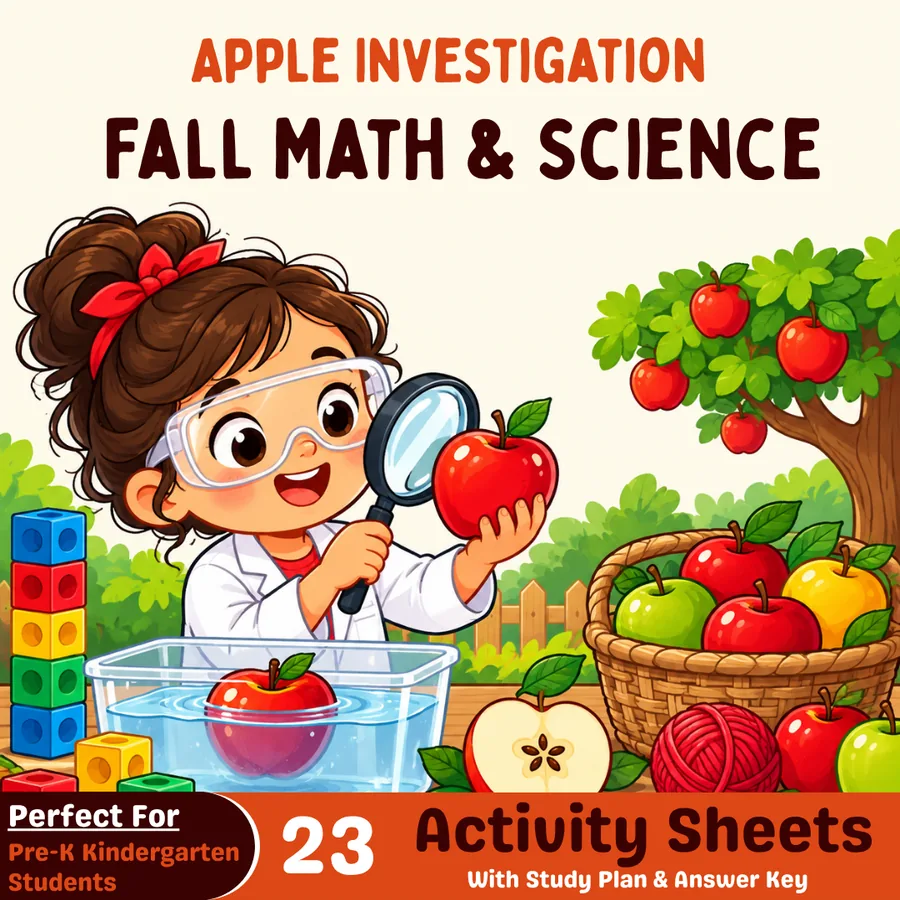
A teacher guide to Apple Week science in Pre-K and K: five senses, predicting, measuring with cubes, seed counting, sink or float and a daily plan.
Read the guide →
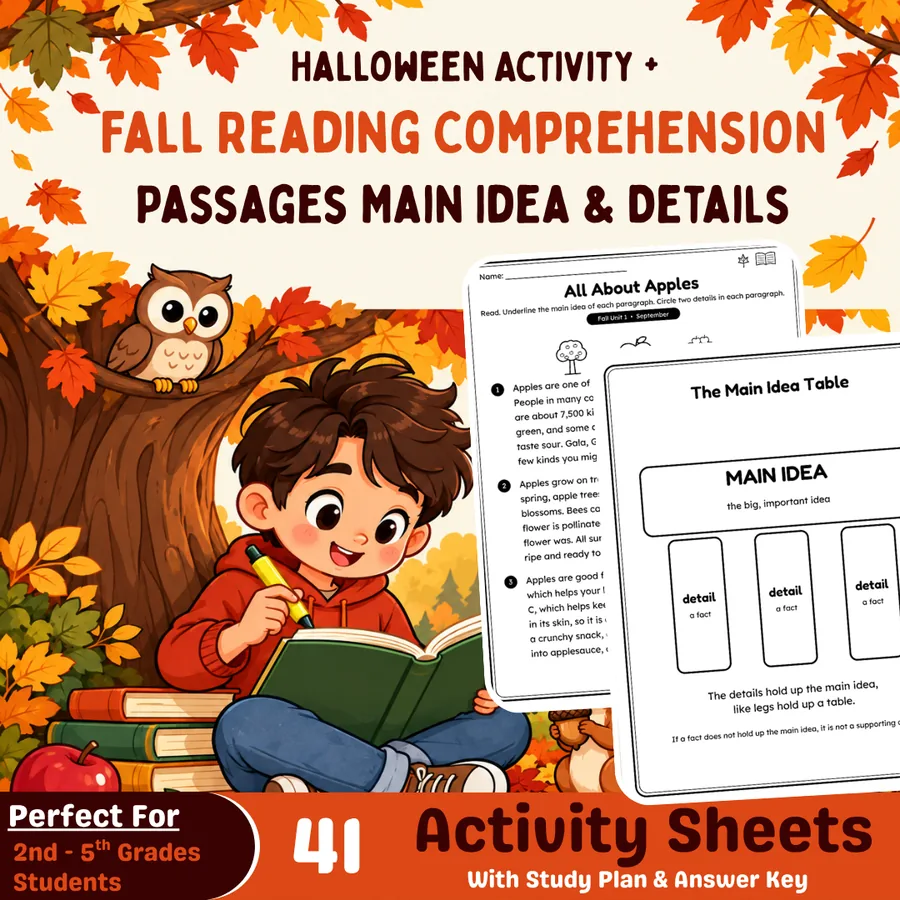
A practical guide to teaching topic, main idea and supporting details in grades 2–4, with mark-up routines, organizers and a 10-week fall plan.
Read the guide →Run October read-alouds in 1st and 2nd grade: discussion, fact vs. opinion, sequencing, story maps, writing and a 5-week Halloween plan that stays friendly.
Read the guide →
How to keep 1st and 2nd graders learning before Thanksgiving with puzzles that teach spelling, syllables, make ten and doubles, plus a 10-day plan.
Read the guide →
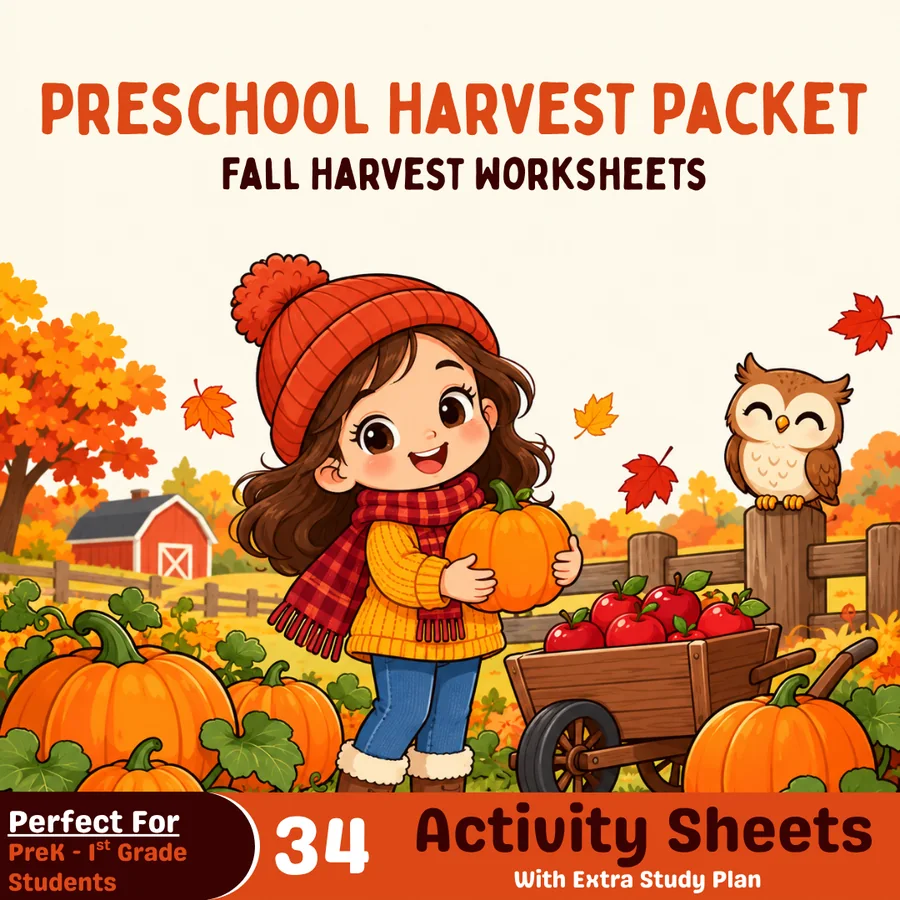
A week-by-week fall harvest plan for preschool, Pre-K and TK: numbers 6 to 10, letters E to H, fine motor skills, fire safety and hands-on harvest activities.
Read the guide →
A complete October plan for kindergarten: phonics, CVC words, sight words, teen numbers, ways to make 10 and calendar skills, with friendly Halloween activities.
Read the guide →
How to teach 4th grade place value to 1,000,000, rounding, the standard algorithm and multi-step word problems, with self-checking Halloween color-by-number practice.
Read the guide →
A teacher's guide to 3rd grade October math: arrays, multiplication facts, rounding and 3-digit regrouping, with self-checking Halloween color-by-number routines.
Read the guide →
A practical guide to teaching Dolch sight words in K–1 with color-by-sight-word mystery pictures: routines, differentiation, centers and a 6-week fall plan.
Read the guide →
A 5-week Pre-K fall plan with daily 10–15 minute lessons: alphabet tracing, beginning sounds, counting to 10, ten frames, patterns and fine motor fun.
Read the guide →