"Eight plus five. Hmm." A first grader holds up eight fingers, then realizes she does not have five more. She starts again, counting on from eight with her head nodding along: nine, ten, eleven, twelve, thirteen. She gets it right, but it takes a while, and the next problem, nine plus seven, takes even longer.
Counting on is a fine strategy, and it is an important step. But for sums that cross ten, there is a faster, more powerful approach: make a ten first. Eight plus five becomes eight plus two (that makes ten) plus three more. Ten plus three is thirteen. No counting required.
Teachers who are new to this strategy tend to have the same handful of questions, and teachers who have taught it for years tend to have a different handful. This guide is organized around those questions, in roughly the order you will meet them while teaching.
What exactly is the make-a-ten strategy?
Make a ten is a way to add two numbers whose sum is between 11 and 20. You break one number apart so that part of it fills up the other number to ten. Then you add what is left.
Take 9 + 6:
- Notice that 9 needs 1 more to make 10.
- Break 6 into 1 and 5.
- Add 9 + 1 to make 10.
- Add 10 + 5 to get 15.
Written out as a number sentence: 9 + 6 = 9 + 1 + 5 = 10 + 5 = 15.
The strategy works because adding to ten is easy. Once children know that 10 + 5 is fifteen (because "fifteen" means one ten and five ones), they never need to count beyond the ten.
Why does it matter so much?
Make a ten connects to nearly everything children will do with numbers in the next few years.
- It builds fluency within 20. Instead of relying on counting, students use relationships they already know.
- It builds place value. Make a ten is really about seeing teen numbers as one ten and some ones, which is the foundation of place value.
- It transfers to bigger numbers. Later, a 2nd grader adding 38 + 5 can think "38 + 2 is 40, plus 3 more is 43." The same move, just bigger.
- It supports subtraction. Thinking about how far a number is from ten helps with strategies like counting back through ten.
- It builds number flexibility. Students learn that numbers can be broken apart and put back together in many ways.
What do students need to know before they start?
This is the most important question, because make a ten collapses if the foundation is not there. Before formally teaching the strategy, check that students can:
- Count and recognize quantities to 10, including seeing a quantity in a ten frame without counting every dot.
- Know the pairs that make ten (1 and 9, 2 and 8, 3 and 7, 4 and 6, 5 and 5). These are often called "friends of ten."
- Understand that numbers can be broken apart. 6 can be 1 and 5, or 2 and 4, or 3 and 3.
- Know that ten and some more makes a teen number. 10 + 4 is 14 without counting.
If any of these is shaky, spend time there first. Most of the trouble students have with make a ten traces back to not knowing friends of ten automatically.
How do I teach friends of ten?
Friends of ten deserve their own week. A few approaches that work well:
Start with fingers. Hold up 7 fingers. "How many fingers are down?" Three. "7 and 3 make 10." Ten fingers is a built-in model.
Use a ten frame. Show 6 counters in a ten frame. "How many empty boxes?" Four. "6 and 4 make 10." Repeat with every number from 1 to 9.
Play "How many more to make ten?" Call out a number; students answer with its partner. Keep it quick and frequent: a few minutes at the start of math, every day.
Hunt for pairs. Give students a set of number cards and ask them to find every pair that makes ten.
Practice the missing part. Write 7 + ___ = 10 and have students fill it in. This is harder than it looks, because it asks students to think about the relationship rather than just add.
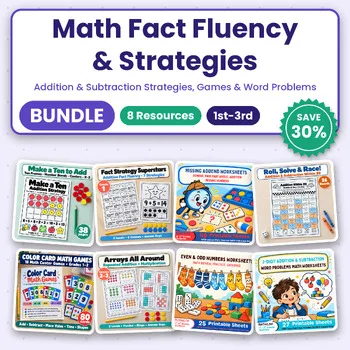
The Make a Ten Addition Strategy has friends-of-ten practice at two levels: How Many More to Make 10? for Level 1, Missing Part of 10 for Level 2, plus a Ten Pair Hunt and Circle the Ten, Then Add. A Friends of Ten poster gives students a reference while they are still learning the pairs.
What role do ten frames play?
Ten frames are the single best tool for making the strategy visible. Here is how to use them.
Step 1: Show both numbers
Use two ten frames. For 8 + 5, put 8 counters in the first frame and 5 in the second. Ask students what they notice. Someone will say the first frame is almost full.
Step 2: Move counters to fill the frame
"How many more does the first frame need to be full?" Two. Physically move two counters from the second frame into the first. Now the first frame has 10 and the second has 3.
Step 3: Read the new total
"How many in the full frame? Ten. How many left over? Three. Ten and three make thirteen." Write 8 + 5 = 10 + 3 = 13.
Step 4: Repeat, then fade the counters
Do this many times with real counters. Then move to drawing dots in ten frames. Then to imagining the ten frame. Children who skip the physical step often memorize the procedure without understanding it.
Sample teacher language: "Fill the ten first. Then see what's left."
The Make a Ten Addition Strategy supports this progression with Fill the Frame at Level 1, Draw and Make a Ten at Level 2 and double ten-frame activities, alongside a ten-frame examples poster.
Where do number bonds fit in?
Number bonds show how a number breaks into two parts. They are usually drawn as a circle for the whole connected to two circles for the parts.
For make a ten, number bonds show the step of breaking apart the second number. For 8 + 5:
- Draw 5 in the whole circle.
- Ask, "8 needs how many to make 10?" Two.
- Write 2 in one part circle.
- Ask, "5 is 2 and what?" Three.
- Write 3 in the other part.
- Now 8 + 2 = 10, and 10 + 3 = 13.
Number bonds are the bridge between the concrete (ten frames) and the abstract (number sentences). Once students can draw a bond, they have a way to record their thinking without counters.
The Break Apart the Number pages in the Make a Ten Addition Strategy give practice at two levels, and the How to Make a Ten poster lays out the steps from start to finish.
How should I sequence the whole unit?
A two-week sequence works well for most 1st grade classes and for kindergarten or 2nd grade groups who are ready. Each day assumes about 20 to 30 minutes of math instruction plus practice.
Week 1: Build the foundation
- Day 1: Friends of ten with fingers and ten frames. Introduce the poster.
- Day 2: How many more to make ten? Oral practice and a short written task.
- Day 3: Missing part of ten and finding ten pairs.
- Day 4: Breaking numbers apart with number bonds. 6 can be 1 and 5, 2 and 4...
- Day 5: Ten and some more. 10 + 3, 10 + 7. Connect to teen numbers.
Week 2: Put it together
- Day 6: Model make a ten with two ten frames and counters.
- Day 7: Students practice with counters, then begin drawing.
- Day 8: Connect to number bonds and number sentences.
- Day 9: Centers and games for practice; small group for anyone struggling.
- Day 10: Word problems and an exit slip to check independence.
This lines up with the 2-week study plan included in the resource, which also has word problems and exit slips at two levels and a Make a Ten Champion certificate to mark the finish.
Which centers keep practice going?
Once the strategy is taught, students need lots of practice in different formats. Good make-a-ten centers include:
Spin and make a ten
Students spin a spinner to get a number, figure out how many more makes ten, and record it. Quick and repeatable.
Matching
Students match a number to its partner to make ten, or match an addition problem to its make-a-ten version (8 + 5 matched to 10 + 3). A cut-and-paste version doubles as fine-motor practice.
Clip cards
Each card shows a problem and three possible answers. Students clip the correct one with a clothespin. Clip cards are self-contained, easy to check with a dot on the back, and work well for independent practice.
Partner games
Partners take turns drawing two number cards and solving with make a ten while the other checks with a ten frame.
The resource includes three centers that cover the first three: Spin and Make a Ten with a paper spinner, a Make Ten Match cut-and-paste and a clip card center with 24 cards and a recording sheet.
Running centers smoothly
- Model each center first. Do one round at the carpet before students try it alone.
- Keep ten frames available. Students who need them should always have them.
- Use recording sheets. They show you who did the work and who just clipped randomly.
- Rotate every 10 to 15 minutes. Long enough to practice, short enough to stay focused.
What mistakes should I watch for?
Breaking apart the wrong number
Some students break apart the first number instead of the second, or break apart a number that does not help. For 8 + 5, they might split 8 instead of 5. Remind them: "Which number is closer to ten? Fill that one up."
Not knowing the partner of ten
If a student hesitates on "How many more does 7 need to make 10?", the strategy will be slow. Go back to friends of ten practice before pushing further.
Losing track of the leftover
Students fill the ten but forget how much was left: 8 + 5 becomes 10 + 5 instead of 10 + 3. Have them write the number bond each time, so the leftover is recorded.
Not knowing 10 + something
Some students still count 10 + 3 as "11, 12, 13." Spend time on teen numbers as one ten and some ones, using bundles of straws or ten-sticks.
Using make a ten when it does not help
For 3 + 4, make a ten is unnecessary. Explain that make a ten is for sums that cross ten. It is a tool for a job, not a rule for every problem.
Applying it mechanically without understanding
A student who can say the steps but cannot show them with a ten frame may have memorized a procedure. Ask them to explain with counters. If they cannot, go back to the concrete step.
How do I differentiate?
For students who need support
- Stay with ten frames and counters longer.
- Start with 9 + something, since 9 needs only one to make ten. Then move to 8 + something.
- Use Level 1 pages with more visual support.
- Practice friends of ten in quick daily warm-ups.
- Work in a small group where you can watch each child move counters.
For students ready for a stretch
- Move to Level 2 pages without counters.
- Ask students to explain the strategy to a partner in their own words.
- Try word problems where students must decide whether to use make a ten.
- Extend to bigger numbers: 28 + 5, 47 + 6.
- Have them write their own make-a-ten word problems.
For students in special education
Concrete materials, visual supports and consistent language make a big difference. Use the same phrase every time, like "Fill the ten first," and keep a poster at the table. Break the strategy into small steps and practice each one separately before putting them together.
For English learners
The math vocabulary, such as ten frame, make ten, partner and left over, may be new. Use gestures and visuals, model each step, and let students show their thinking with counters rather than words.
How can families help at home?
Make a ten fits easily into everyday life.
- Finger play. Hold up some fingers and ask, "How many more to make ten?"
- Egg cartons. A carton with ten cups (cut two off a dozen) works as a ten frame. Fill some cups with buttons or beans and ask how many more fill it up.
- Grocery counting. "We have 8 apples. If we buy 5 more, how many will we have? Can you make a ten first?"
- Card games. Play "Make Ten": lay out cards and find pairs that add to ten.
When you send home practice pages, include a short note explaining the strategy so families use the same approach instead of teaching a different method.
Frequently Asked Questions
What grade is make a ten taught in?
Make a ten is commonly taught in 1st grade, with the groundwork of friends of ten and ten frames laid in kindergarten. Second graders often review it and extend the same idea to larger numbers.
Is make a ten the same as counting on?
No. Counting on means starting from one number and counting up. Make a ten means breaking a number apart to fill a ten, then adding the rest. Both are useful, but make a ten relies on number relationships rather than counting, so it tends to be faster for sums over ten.
How do I know when a student has mastered it?
Look for a student who can solve problems like 8 + 6 or 9 + 7 quickly by making ten, explain their thinking, and show it with a ten frame or number bond. Exit slips and word problems help you check independence.
Should students always use make a ten?
No. It is one strategy among several. For small sums, other approaches are often quicker, and for doubles or near doubles, students might use those facts instead. The goal is for students to choose a strategy that fits the problem.
What if a student just cannot remember the pairs that make ten?
Go back to concrete practice with fingers and ten frames, and practice the pairs a few minutes every day. A Friends of Ten poster at the table helps until the pairs become automatic.
Can kindergarteners learn make a ten?
Kindergarteners can and should work on the foundations: friends of ten, ten frames and the idea that numbers can be broken apart. Some will be ready for the full strategy by spring; others will be ready in 1st grade.
Bringing It Back to the Ten Frame
The first grader at the start of this guide, counting on from eight one number at a time, is not doing anything wrong. She is ready for a better tool. With friends of ten in place, a ten frame to show the move and a number bond to record it, eight plus five becomes ten plus three, almost instantly. That small shift in thinking is one of the most important steps toward fluent addition, and it sets students up for place value and bigger numbers in the years ahead.