November in a PreK or kindergarten classroom has its own rhythm. The newness of the first months has worn off, routines are mostly in place, and children are ready for a little more independence. At the same time, the calendar fills up fast: conferences, a short Thanksgiving week, assemblies, maybe a cold that takes you out for a day. The teachers who enjoy November most tend to be the ones who set it up once at the start and let the routines carry the month.
This guide is organized the way you would actually set things up: a checklist for the weekend before, then each routine one at a time (centers, poetry, question of the day, writing center, mini books), then a four-week arc, and finally the sub plan you hope you will not need. It is written for Pre-K, TK and kindergarten, and much of it also works in special education and homeschool settings.
The Weekend-Before Checklist
Work through this list once and most of November is ready to go.
- Pick your themes. Two themes are plenty for a month. Thankful turkeys and harvest time pair naturally: the first leans into Thanksgiving and gratitude, the second into corn, pumpkins, apples and the work of gathering food.
- Choose your centers. Aim for about five math and five literacy centers you can rotate across the month. You do not need to introduce them all on day one.
- Print and laminate. Center mats, sorting cards, puzzles and word cards will be handled a lot. Laminate anything that will be reused.
- Label bins. One bin per center, with a picture label so non-readers can find and return materials.
- Prep the poem. Print a large poster for the wall, sentence strips for the pocket chart and individual copies for poetry folders.
- Set up the question of the day board. A header, YES and NO labels and a stack of questions in order.
- Refresh the writing center. Swap in seasonal word cards, theme posters and fresh paper.
- Copy mini books. Make a class set of each so they are ready on the days you introduce them.
- Build the sub folder. Do it now, while you are healthy and calm. More on this below.
- Send a family letter. A short note about the month's themes helps families talk about school at home.
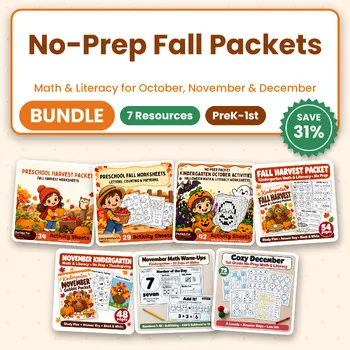
The November PreK & Kindergarten Packet is built around this kind of setup, pulling Thankful Turkeys and Harvest Time centers, two poems, a Question of the Day set, a writing center, four mini books and a ready-to-use sub plan into one 120-page packet with a 4-week study plan.
Routine 1: Centers
What to include
A strong November center rotation for PreK and kindergarten covers a few core skills in each subject.
Math centers might practice:
- Counting objects and matching to a number (counting feathers on a turkey is a classic)
- Sorting and naming shapes
- Building and extending patterns (corn kernels in two colors work well)
- Number recognition through roll-and-cover games
- Comparing and measuring length with nonstandard units
Literacy centers might practice:
- Matching uppercase and lowercase letters
- Sorting pictures by beginning sound
- Recognizing and matching rhymes
- Clapping and counting syllables
- Building simple CVC words
Five math centers in this packet line up with that list: Feather Count, Shape Sort, Corn Patterns, Roll and Cover, and Measure the Harvest. The five literacy centers are Turkey Letter Puzzles, Beginning Sound Sort, Rhyme Pie, Syllable Corn and Build the Word (CVC).
How to introduce centers
Do not open all ten centers at once. Introduce one or two each day during the first week.
- Model at the carpet. Show the materials, do the task yourself while thinking aloud, then let one or two children try in front of the group.
- Practice cleanup. Show exactly how materials go back in the bin. This is as important as the task itself.
- Run the center with you nearby. The first time a center is open, stay close to answer questions and catch confusion early.
- Then let it run. Once children know a center, it can run while you work with a small group.
Using two levels
In any PreK or kindergarten room, some children will be counting to five while others count past twenty, and some will be identifying letters while others build words. Two levels of the same center let everyone do the same activity at the right challenge. Many children like knowing they are doing "the same thing" as their friends, even if their card looks a little different.
A simple system: color-code bins or put a small dot on Level 2 materials. Tell children which color to choose, or let them try one and switch if it feels too easy or too hard.
Managing rotations
- Keep groups small. Three or four children per center works well for this age.
- Use a visual rotation chart. Picture cards for each center and children's names or photos make it clear where everyone goes.
- Plan 10 to 15 minutes per rotation. Kindergarteners can stretch toward 15 by November; PreK children often need closer to 10.
- Use a consistent signal to rotate. A chime, a song or a clean-up chant.
Routine 2: The Weekly Poem
A single poem, used across a week or two, does a surprising amount of literacy work. Children learn concepts of print, rhyme, rhythm, new vocabulary and the feel of reading fluently, all from a few lines they come to know by heart.
A five-day poem cycle
- Day 1: Listen and enjoy. Read the poem aloud from the large poster. Read it again. Ask what children noticed.
- Day 2: Echo read. You read a line, children repeat it. Point to each word as you read.
- Day 3: Pocket chart work. Put the poem in a pocket chart with sentence strips. Mix up two strips and let children help fix the order. Find words that rhyme.
- Day 4: Retell. Use picture cards to retell what happens in the poem. Children can work on retell mats in pairs.
- Day 5: Poetry folders. Children glue a copy into their poetry folders, illustrate it and read it to a friend.
The packet's two original Thanksgiving and harvest poems come with exactly these supports: large posters, student poetry pages, pocket chart sentence strips, retell picture cards and retell mats.
Teacher language that helps
- "Let's read it like a turkey: gobble, gobble, nice and loud!" (Using voices keeps rereading fun.)
- "Can you find the word fall in our poem? Come point to it."
- "Which two words sound the same at the end?"
Poetry folders
A poetry folder is a three-prong folder or a simple stapled booklet where children keep every poem they learn. By the end of the year, it is a book they can read independently, and it makes a lovely take-home in spring.
Routine 3: Question of the Day
A daily question is one of the easiest routines to add to morning arrival, and one of the most useful. It builds name recognition, counting, comparing, graphing and conversation, all before the first lesson begins.
How it works
Each day, post a simple yes-or-no question on a board. As children arrive, they move their name card or photo to the YES side or the NO side. During morning meeting, count each side together and compare.
Sample questions for November
- Do you like pumpkin pie?
- Have you ever seen a real turkey?
- Do you like apples?
- Is it cold outside today?
- Have you ever jumped in a pile of leaves?
- Do you like corn?
Making it count
- Count both sides together. "Let's count the YES names. One, two, three..."
- Compare. "Which side has more? How many more?"
- Talk about it. Ask two or three children to explain their answer in a full sentence: "I said yes because..."
- Read the question together. Point to each word. Over time, children start reading it on their own.
The Question of the Day set in this packet includes a header poster, YES and NO cards and 48 question cards, which is enough for every school day in November with plenty to spare.
Routine 4: The Writing Center
PreK and kindergarten writers are at very different places. Some are making marks and scribbles; some are writing letter strings; some are labeling pictures; a few are writing short sentences. A good writing center welcomes all of them.
What to stock
- Seasonal word cards with a picture and the word in uppercase and lowercase, so children can copy words they want to use
- Theme posters with labeled pictures for reference
- "How to Write" and "I Can Write!" posters that remind children of the steps: think, draw, write, read it back
- A WRITE banner to make the center feel like a special place
- Paper at different levels: tracing pages, copying pages and open write-and-draw pages
The packet stocks this center with 64 seasonal word cards in lowercase and uppercase, theme posters, "How to Write" and "I Can Write!" posters, WRITE pennant banners, and three page types: Trace and Write (Level 1), Look and Write (Level 2) and write and draw.
Supporting different writers
- Tracing builds letter formation and confidence. Ideal for PreK and early kindergarten.
- Look and write asks children to copy a word from a card. A natural next step.
- Write and draw invites children to draw a picture and add their own words or sentence.
Encourage every attempt. A child who draws a turkey and writes "TRKE" is using letter-sound knowledge. Celebrate it.
Routine 5: Mini Books
Small, simple books that children can read, color and take home are a staple of PreK and kindergarten for good reason. They build print concepts, confidence and a sense of being a reader.
How to use them
- Read together first. Model reading the book, pointing to each word.
- Read again with children. Choral read.
- Let children color and personalize. This gives them ownership.
- Read to a partner. Then to you.
- Send home. Children read to their families.
This packet contains four mini books, Snip, Snip!, Dot, Dot, Not a Lot!, I Am Thankful and Harvest Time, which you can spread across the month as the themes shift.
A Four-Week November Arc
Here is one way to sequence the month. Adjust to your school calendar.
Week 1: Launch the themes and routines
- Introduce the Thankful Turkeys theme.
- Start Question of the Day.
- Introduce the first poem.
- Open two or three centers, modeling each.
- Read the first mini book.
Week 2: Build independence
- Open the remaining centers gradually.
- Continue poem work, moving to pocket chart and retell.
- Begin regular writing center time.
- Start small groups while centers run.
Week 3: Shift to Harvest Time
- Introduce the second poem and harvest vocabulary.
- Rotate in harvest-themed centers.
- Read the harvest mini book.
- Use the skills checklist to see who needs extra support.
Week 4: Gratitude and review
- Focus on thankfulness through writing and the I Am Thankful mini book.
- Review centers children enjoyed most.
- Celebrate learning with a certificate.
- If the week is short, simplify: keep morning routines, run favorite centers, and save new material for December.
The 4-week study plan in the November PreK & Kindergarten Packet follows a similar path through Thankful Turkeys and Harvest Time, and a family letter, a skills checklist, a Super Thankful Learner certificate and answer keys support the month.
The Sub Plan You Build Before You Need It
Sooner or later, a cold, a sick child at home or a meeting will pull you out of the classroom. A sub plan built in a hurry the night before rarely goes well. A sub plan built in early November, when you have time to think, can make the day nearly seamless.
What a good sub folder includes
- A daily schedule with times, specials and lunch clearly marked.
- A note to the substitute with routines, signals, helpful students and anything they need to know.
- Class list and seating, with any allergies, medical needs and pickup arrangements.
- Emergency procedures: fire drill route, lockdown procedure and who to call.
- Ready-to-go activities that children can do with minimal instruction.
- A substitute report form so you know how the day went.
Choosing sub activities
Pick activities children already know. A sub should never introduce a brand-new center or concept. Good choices include:
- The current poem (children can read it with the sub)
- A familiar mini book
- Coloring or tracing pages connected to the theme
- Question of the Day, which runs itself once children know it
- A read-aloud with a simple drawing response
The packet's sub plan section includes a ready-to-use substitute plan, a daily schedule template, a note to the substitute, a substitute report form and three emergency activity pages. Fill in your own times and details, add a class list, and keep the folder somewhere obvious.
Keep it current
Revisit the sub folder every few weeks. Update the schedule if specials change, swap in the current poem, and replace activities children have outgrown.
Supporting Every Learner
Students in special education
Visual schedules, picture labels on bins and predictable routines help many children. Use Level 1 materials, reduce the number of pieces in a center, and allow extra time. Repetition is a feature, not a problem: doing the same center several times builds confidence.
English learners
Picture word cards, poems with actions and retell picture cards make language visible. Pair new English speakers with a buddy. Accept pointing and gesturing as participation, especially early on.
Children ready for more
Offer Level 2 materials, ask children to write a sentence instead of a word, or invite them to read the poem to the class. Older or more advanced kindergarteners can write their own question of the day.
Keeping Families in the Loop
Send home a short family letter at the start of the month explaining the themes and how families can help. A few easy ideas:
- Read the mini books together as they come home.
- Recite the poem. Children love performing for family.
- Talk about the question of the day. "What was today's question? How did you answer?"
- Count and sort at home. Fall items like leaves, acorns or corn kernels are perfect for counting and sorting.
- Share gratitude. At dinner, each person names one thing they are thankful for.
Frequently Asked Questions
How many centers should I run at once in PreK or kindergarten?
Four to six centers at a time is manageable for most classes, with three or four children in each. Rotate which centers are open over the month rather than running all ten every day.
How long should a poem stay up?
One to two weeks per poem works well. Children need many repetitions to learn it by heart, and the familiarity is what makes it useful for reading practice.
Is question of the day appropriate for preschool?
Yes. Even young preschoolers can move a photo or name card to YES or NO. Counting and comparing the two sides builds early math, and talking about answers builds language.
What should I put in a kindergarten sub plan?
A schedule, a note about routines and signals, emergency procedures, a class list with medical information, familiar activities and a report form. Choose activities children already know, not new material.
How do I keep centers from getting chaotic?
Model each center thoroughly, practice cleanup, introduce centers gradually, keep groups small and use a clear rotation signal. Most chaos comes from rushing the introduction.
Can this kind of plan work in a homeschool setting?
Yes. Centers become activity trays, the poem becomes a family reading routine and question of the day can include siblings or parents. The four-week arc adapts easily to a single child.
Ready for the Month Ahead
November goes smoothly when routines carry the day. Set up centers once and introduce them slowly. Let a poem and a daily question anchor every morning. Stock the writing center so every child can find a starting point. Copy the mini books, build the sub folder before you need it, and send a letter home. With that groundwork done in the first weekend, you can spend the rest of the month on the part that matters most: watching your youngest learners grow.