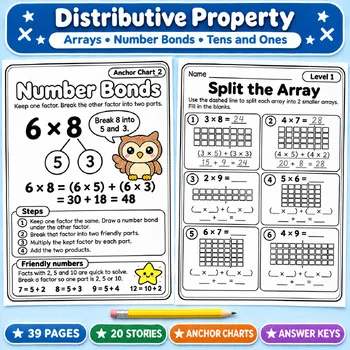
Arrays, number bonds and tens and ones to make the distributive property click: students break a big fact into two smaller facts they already know, so 6 × 8 becomes (6 × 5) + (6 × 3). Every core skill comes in two levels, with anchor charts and answer keys.
The distributive property clicks when a child can see a big multiplication fact split into two smaller ones they already know. This set teaches exactly that: 6 × 8 becomes (6 × 5) + (6 × 3), which is 30 + 18, which is 48. Students split an array with a line, use a number bond to find the friendly parts, and fill in equations with partial products. The three strategies — break apart an array, use a number bond, and break apart tens and ones — each get their own anchor chart, so the strategy is on the wall while the children practice it.
Every core skill comes in two levels. In Level 1 a starting point is given — a dashed split line, or one part of the number bond — and in Level 2 the students choose their own split. The challenge pages use tens and ones with an area model, so 13 × 5 becomes 50 + 15, and the word problems show when to reach for these strategies.
The set is built to run as a two-week unit, with a two-week study plan, How to Use and Teacher Notes with common mistakes, 4 exit tickets, a Quick Check of 8 items and an "I can" tracker. A Find the Mistake page with 6 student work samples turns error-spotting into practice, and the notebook charts cut and glue into math notebooks.
The pages are black and white on US Letter paper, and the listing states 39 pages. Answer keys are included for every practice page. The grade range is 3rd through 4th grade: the description calls it a 3rd grade unit and lists 4th grade review among the uses, and the listing's Highlights field says 3rd–4th. The listing names CCSS 3.OA.B.5.
3 full-page anchor charts: Break Apart an Array, Number Bonds, and Break Apart Tens and Ones
4 notebook charts to cut and glue: the three strategies plus a vocabulary card
Split the Array in Level 1 (dashed split line given) and Level 2 (students draw the line)
Number Bonds in Level 1 (one part given) and Level 2 (open)
Fill in the Equation in Level 1 and Level 2, 10 problems each
Tens and ones, word problems and checks
Tens and Ones with an area model in Level 1 and Level 2 (2-digit × 1-digit challenge)
Find the Mistake: 6 student work samples to check and fix
Word Problems in Level 1 with hints and Level 2 open
4 exit tickets, a Quick Check (8 items) and an "I can" tracker
Teacher support and extras
Two-week study plan, How to Use and Teacher Notes with common mistakes
Answer keys for every practice page
The listing names CCSS 3.OA.B.5
PDF, US Letter, black and white, 39 pages in total
Ways to use it
3rd grade multiplication units
Distributive property mini-lessons with anchor charts
Math centers and small groups
RTI and intervention review
Homework and independent practice
4th grade review and 2-digit by 1-digit multiplication
Why it works
A child who can split 6 × 8 into two facts they know has a strategy, not just an answer. Arrays, number bonds and tens and ones give them three ways to split, and the two levels mean every child starts where they are.
Questions & answers
What grades is it for?
It is written for 3rd and 4th grade. The description calls it a 3rd grade unit and lists 4th grade review among the uses, and the listing's Highlights field says 3rd–4th.
What strategies does it teach?
Three: break apart an array, use a number bond, and break apart tens and ones with an area model. Each strategy has a full-page anchor chart and a notebook chart to cut and glue.
How are the two levels different?
Every core skill comes in Level 1 and Level 2. In Level 1 a starting point is given, such as a dashed split line or one part of the number bond. In Level 2 the students choose their own split.
Is there an answer key?
Yes. Answer keys are included for every practice page, along with 4 exit tickets, a Quick Check of 8 items and an "I can" tracker.
Ready to print Distributive Property of Multiplication?$3.25 · instant PDF download on TPT
 🎄
 Created byActivity Express