 🎓
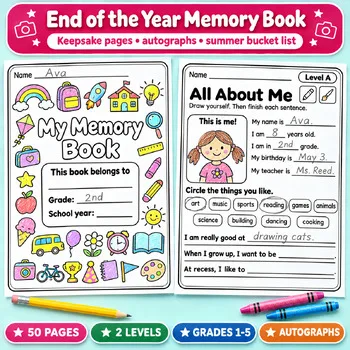
End of the Year Memory Book & Autographs: Two Levels for Grades 1–5
 Created byActivity Express
End of the year memory book for grades 1–5: 16 keepsake pages in two levels, autograph pages, a mini book and a certificate.
$5.49
Get it on TPT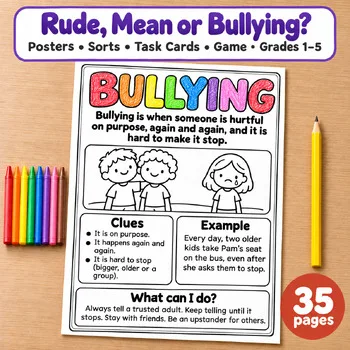 🤝
Children use the word bullying for almost any unkind moment, and that makes it hard for them to know when to get help. This 5-day lesson gives grades 1–5 a clear three-clue method for telling rude, mean and bullying behavior apart, then lets them practice it with sorting, task cards, a game and role play.
You'll check out and download on Teachers Pay Teachers. Prices there may include a sale.
This 5-day SEL lesson helps children in grades 1–5 tell the difference between rude, mean and bullying behavior, using a three-clue method they can apply to real situations. Children learn what each kind of behavior looks like, what to do about it, and how to be an upstander for others. The lesson comes in two differentiated levels, so the same ideas work for a first grader and a fifth grader.
Three teaching posters introduce the words: Rude, Mean and Bullying, each with a definition, a picture, three clues, an example and a 'What Can I Do?' section. Reference charts support the teaching, including an 'Is It Bullying?' flow chart, a 'What Can I Do?' decision chart and a 'Reporting or Tattling?' chart. A three-clue teaching guide and behavior-focused discussion tips help the teacher lead the conversations, with guidance for sensitive student disclosures.
Practice comes in layers. Differentiated pages at Levels 1 and 2 cover 'What Is the Difference?', definitions, guided practice and real-life examples. Sorting mats with scenario cards ask children to sort situations as rude, mean or bullying, and 24 scenario task cards, eight of each kind, come with a student recording sheet. A Kindness Path board game with an answer check card and 12 role-play cards give children ways to practice respectful responses and problem-solving.
Upstander work runs through the week: 'Be an Upstander,' 'Five Ways to Help' and 'My Upstander Plan,' plus differentiated reflection pages called 'What Would You Do?' where children draw, write, discuss and name trusted helpers. A 'My Kindness Promise' page, a 'Show What You Know' quiz at both levels, a family letter, an Upstander Award and complete answer keys finish the set. A 5-day lesson plan, teacher notes and printing tips support the planning.
📖 Teaching guide · 13 min readTeaching the Difference Between Rude, Mean and Bullying: A Five-Day SEL Plan for Grades 1–5Read the guide →Featured in: World Kindness Day Activities for the Classroom: Ideas for PreK–5 That Actually Change Behavior
Children cannot ask for the right help until they can name what happened. The three-clue method gives them plain language for rude, mean and bullying, and the sorting, task cards and game give them enough practice that the words stick when a real situation comes up.
It is written for grades 1–5, with two differentiated levels. Level 1 suits younger children and Level 2 suits older ones, and the same posters and charts work for both.
Children learn a three-clue method for telling rude, mean and bullying behavior apart, then practice it with sorting mats, scenario cards, a board game and role-play cards.
Yes. The lesson includes a 'Reporting or Tattling?' chart and a 'What Can I Do?' decision chart, plus guidance for the teacher on handling sensitive student disclosures.
Yes. Upstander activities include 'Be an Upstander,' 'Five Ways to Help' and 'My Upstander Plan,' plus a 'My Kindness Promise' page and an Upstander Award.
🎓
Created byActivity ExpressEnd of the year memory book for grades 1–5: 16 keepsake pages in two levels, autograph pages, a mini book and a certificate.
 💌
Created byActivity Express
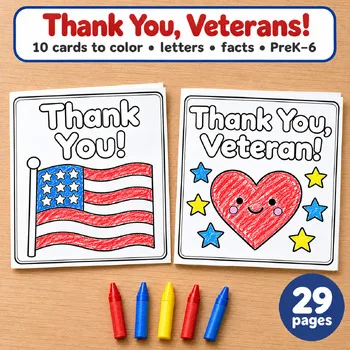
Veterans Day thank-you cards and letters for PreK–6th: 10 colouring cards, two-level writing, a facts poster, postcards and an envelope template.
 💬
Created byActivity Express
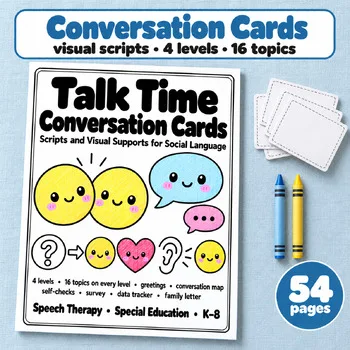
Four-level conversation cards with visual scripts for K–8 speech therapy and social skills: yes/no, WH, topic talk and keep-it-going, 16 topics.
 ☕
Created byActivity Express
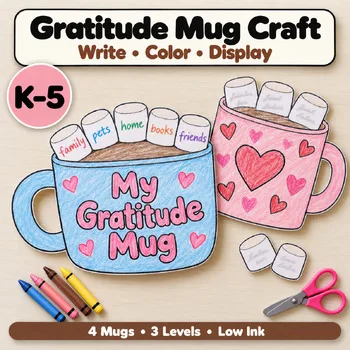
A Thanksgiving hot cocoa gratitude craft for K–5: 4 mug designs, leveled marshmallow writing, talk cards, writing pages and a bulletin board kit.