Reading Comprehension, Reading & Literacy, Centers & Games
Pages
50 pages
Format
PDF
Fall gives text structure something real to hold onto: leaves changing color, animals getting ready for winter, apples turning into cider. This set builds ten short passages around those topics, two for each of the five structures, so students meet cause and effect, compare and contrast, problem and solution, description and sequence in texts that feel like November.
Text structure is one of those skills that sounds abstract until a student meets it inside a real paragraph. This packet keeps the reading short — every passage runs 131 to 157 words — and the topics close to November: leaves, squirrels, hibernation, harvest moons and snowflakes. With two passages for each of the five structures, students get a second chance at every structure instead of one shot and done.
Each passage comes with three comprehension questions and a structure-identification question, and students circle the signal words as they read. That circling matters: it turns a vague feeling about how a text is organized into something a student can point at. The twenty graphic organizers run at two levels, so a student who needs a worked first box and sentence frames gets them, while a student ready for a blank organizer can write a full summary paragraph using signal words.
The review materials make the set easy to finish well. Fifteen “Name That Structure” task cards let students sort structures quickly, and the eight-item quiz gives you a clean check at the end. The four-week plan and per-passage routine lay out the pacing, so the packet can run as a short daily routine across November rather than a single heavy lesson.
It fits guided reading groups, informational-text centers, homework and sub plans, and the listing names RI.4.5 and RI.3.8 as test-prep uses. Fall topics also make it a natural bridge into science and social studies reading, since several passages explain how animals and plants handle the season.
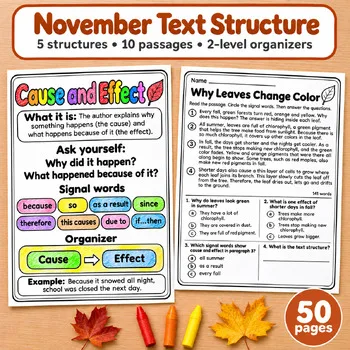
5 anchor charts, one per structure, each with a definition, a key question, signal words, an organizer and an example
A signal-word bank students can keep beside them while they read
Charts that name what to look for in each structure before students open a passage
The ten passages
10 fall passages, 131–157 words each, in 4 numbered paragraphs, 2 per structure
Cause and effect: leaf colour and squirrels planting forests
Compare and contrast: hibernation and migration, Thanksgiving in the US and Canada
Problem and solution: animals keeping warm and farmers protecting crops from frost
Description: the monarch winter home and the harvest moon; sequence: apple to cider and snowflake formation
3 comprehension questions plus a structure-identification question per passage, with students circling signal words
Organizers, review and teacher support
20 graphic organizers, 2 per passage — Level 1 with a worked first box and sentence frames, Level 2 blank with a summary paragraph using signal words
A review set of 15 “Name That Structure” task cards with a recording sheet and an 8-item quiz
A 4-week plan, a per-passage routine, teacher notes and answer keys with sample organizer answers
Ways to use it
A four-week text-structure routine across November
Guided reading groups working through one structure at a time
Informational-text centers with the anchor charts on display
Early-finisher and review work with the “Name That Structure” task cards
4th-grade reading comprehension homework
Sub plans and homeschool reading lessons
Test preparation practice for the structures the listing names
Why it works
Short passages keep the focus on structure instead of stamina, and the fall topics give every structure a concrete example students already care about. Two levels on the organizers mean the same passage works for a student who needs sentence frames and one who is ready to write a summary, and the task cards and quiz close the loop with a quick check that the structures stuck.
Questions & answers
What grades is it for?
Grades 3–6. The passages are short, 131–157 words each, and the graphic organizers come in two levels, so younger readers get sentence frames and a worked first box while older students write a full summary paragraph.
Which text structures are covered?
Five: cause and effect, compare and contrast, problem and solution, description, and sequence. There are two passages per structure, ten in total, plus an anchor chart for each one.
How is the packet organized for teaching?
It includes a 4-week plan and a per-passage routine, with teacher notes and answer keys that include sample organizer answers. Each passage has 3 comprehension questions and a structure-identification question.
Is there a review or assessment included?
Yes. There is a set of 15 “Name That Structure” task cards with a recording sheet and an 8-item quiz, alongside the per-passage questions and the two-level graphic organizers.
Ready to print November Text Structure Passages?$4.49 · instant PDF download on TPT
A theme park reading escape room for grades 3–6: six ride challenges on informational text, fact and opinion, data tables, timelines and context clues.
 🧠
 Created byActivity Express