Figurative language stops being a list of terms to memorize when students meet it inside a story they actually want to finish. These eight original stories give grades 4–8 fourteen or fifteen examples to find in every single one, then turn that spotting into discussion, rewriting and revision.
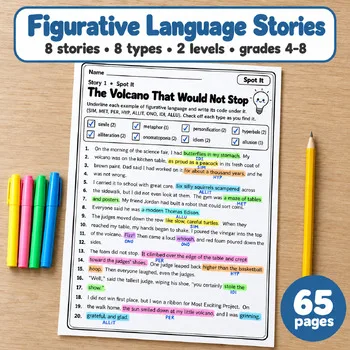
These Figurative Language Stories give grades 4–8 a reason to slow down and notice how writers make ordinary moments feel vivid. The 65-page, black and white PDF holds eight original stories, each carrying 14 to 15 examples of figurative language across eight device types: simile, metaphor, personification, hyperbole, idiom, alliteration, onomatopoeia and allusion.
Every story follows the same five-activity routine. In Spot It, students read, underline each example, label the device and check their work with a student checklist, using line numbers to stay on the same line. Think It has two levels: Level 1 gives five multiple-choice questions with line references for grades 4–5, intervention and ELL; Level 2 gives five evidence-based written responses for grades 6–8 and enrichment.
Then the routine moves from reading into writing. In Twist It, students rewrite five examples while keeping the same device, studying two student models first. In Write It, they revise the story itself, replacing its figurative language with original examples and underlining their revisions.
A field guide introduces all eight device types, each with a definition, what to look for, an example and a teaching tip. The teacher section adds a 5-day routine, a 9-week study plan, a Level 1 and 2 teaching guide, ways to use the resource, a labeling system guide, printing tips and a contents page.
For assessment, the cold read passage The Kite Festival offers a fresh text with 13 examples, five multiple-choice questions and two written response questions, plus scoring suggestions and a scoring guide. Students track progress with a My Story Tracker and earn a Figurative Language Pro certificate. Answer keys are fully annotated with underlined examples, device labels and line numbers.
Eight original stories: The Volcano That Would Not Stop, Snow Day!, Where Is Biscuit?, Grandma's Kitchen, The Big Game, Storm at Camp, The New Kid and The Talent Show
A field guide for all 8 devices, each with a definition, what to look for, an example and a teaching tip
A 5-day routine and a 9-week study plan, with teacher notes and a labeling system guide
Five activities with every story
Spot It: read, underline every example, label each device, with a student checklist and line numbers
Think It Level 1: 5 multiple-choice questions with line references for grades 4–5, intervention and ELL
Think It Level 2: 5 evidence-based written response questions for grades 6–8 and enrichment
Twist It: rewrite five examples keeping the same device, with two student models
Write It: revise the story, replace the figurative language with original examples and underline revisions
Assessment, tracking and answer keys
Cold read passage The Kite Festival with 13 examples, 5 multiple-choice questions and 2 written response questions
Scoring suggestions and a scoring guide for the cold read
My Story Tracker and a Figurative Language Pro certificate
Fully annotated story keys with underlined examples, device labels and line numbers
Level 1 keys and Level 2 sample responses
Ways to use it
A 5-day figurative language routine with one story per cycle
Close reading lessons in the ELA block
Reading intervention and small-group work
ELA centers with the Spot It and Twist It pages
Writing practice through the Write It revision task
Bell work, homework and test prep review
Why it works
The same five activities repeat with every story, so the routine becomes automatic and students can put their energy into the language instead of figuring out the task. Two response levels let a class read the same story together while fourth graders answer with line-referenced choices and eighth graders build evidence-based written responses.
Questions & answers
What grades is it for?
It is written for grades 4–8. Think It Level 1 suits grades 4–5, intervention and ELL, while Think It Level 2 suits grades 6–8 and enrichment.
Which figurative language devices does it cover?
Eight: simile, metaphor, personification, hyperbole, idiom, alliteration, onomatopoeia and allusion. A field guide covers each one with a definition, what to look for, an example and a teaching tip.
How many examples are in each story?
Each of the eight original stories has 14–15 figurative language examples. The cold read passage, The Kite Festival, has 13.
What does the assessment look like?
The cold read passage The Kite Festival comes with 5 multiple-choice questions and 2 written response questions, plus scoring suggestions, a scoring guide and full answer keys.
Ready to print Figurative Language Stories?$6.49 · instant PDF download on TPT
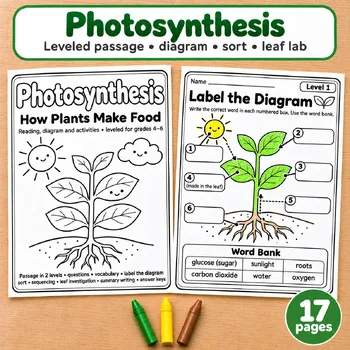
A leveled photosynthesis reading passage for grades 4–6: two reading levels, vocabulary, a labelled diagram, sorting and sequencing, and a leaf investigation.
 ⭐
 Created byActivity Express