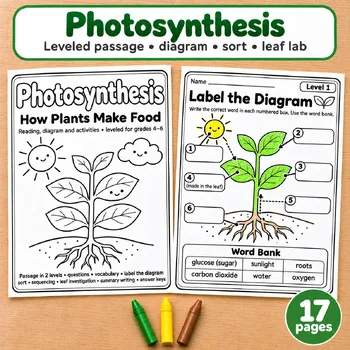
Photosynthesis is a hard idea to meet from words alone, so this packet pairs the reading with things students can do: label a diagram, sort inputs from outputs, put the steps in order, and watch a real leaf for a week. The passage “How Plants Make Food” comes in two levels, so the same lesson reaches a 4th grader and a 6th grader.
This is a one-week science reading set built around a single question: how do plants make food? The passage “How Plants Make Food” is written at two levels — 174 words in six paragraphs for Level 1, 299 words in seven paragraphs for Level 2 — and both versions use numbered paragraphs so students can point to the exact place an answer came from.
The vocabulary work follows the same two-level pattern. Level 1 matches words to meanings; Level 2 uses a word bank and context sentences. The six words are chlorophyll, chloroplast, stomata, glucose, producer and consumer, and the labelled diagram gives students a picture to attach them to — with a word bank at Level 1 and without one at Level 2, plus questions about inputs and outputs.
What makes the packet more than a reading exercise is the hands-on work. Students cut and sort inputs from outputs, answer four true/false items, glue the six steps of photosynthesis in order, and then run a real investigation: a seven-to-ten-day log asking “Does a Leaf Need Light?” A summary planner and writing lines close the week with science writing.
At seventeen pages it is a compact unit, and the teacher lesson plan and notes lay out the week. It fits a plants or life-science unit, small-group science reading, homework and review, science sub plans in grades 4–6, and homeschool life science.
Passage “How Plants Make Food” in 2 levels — Level 1, 174 words in 6 paragraphs; Level 2, 299 words in 7 paragraphs, both with numbered paragraphs
Comprehension questions in 2 levels: multiple choice plus short answer, with Level 2 short answers citing a paragraph number
A science-writing summary planner and writing lines
Vocabulary and diagram
Vocabulary in 2 levels (Level 1 matching; Level 2 word bank and context sentences) covering chlorophyll, chloroplast, stomata, glucose, producer and consumer
Labelled diagram in 2 levels: Level 1 with a word bank, Level 2 without, plus inputs and outputs questions
Hands-on work and teacher support
Inputs and outputs cut-and-sort plus 4 true/false items
A 6-step “Steps in Order” cut-and-glue activity
A 7–10 day “Does a Leaf Need Light?” investigation log
Teacher lesson plan, notes, contents and 2 pages of answer keys
Ways to use it
A one-week photosynthesis unit in 4th or 5th grade science
Small-group science reading with the two levels
A plants or life-science reading unit
Hands-on practice: sorting inputs and outputs and sequencing the steps
A 7–10 day leaf-and-light investigation at school or home
Photosynthesis homework and review
Science sub plans in grades 4–6
Why it works
Reading about photosynthesis only works if students can picture the process, and this packet gives them three ways in: the words, the labelled diagram, and their own hands sorting and sequencing. Two levels keep the same lesson open to a 4th grader and a 6th grader, and the leaf investigation turns an abstract idea into something students watched happen.
Questions & answers
What grades is it for?
Grades 4–6. The passage, questions, vocabulary and diagram all come in two levels, so the same lesson fits 4th graders and stretches to 6th graders.
How long does it take to teach?
The listing gives a teaching duration of one week. The packet includes a teacher lesson plan and notes, and the investigation log runs 7–10 days.
What vocabulary does it cover?
Chlorophyll, chloroplast, stomata, glucose, producer and consumer. Level 1 uses matching; Level 2 uses a word bank and context sentences.
What hands-on activities are included?
An inputs and outputs cut-and-sort with 4 true/false items, a 6-step “Steps in Order” cut-and-glue activity, and a 7–10 day “Does a Leaf Need Light?” investigation log, plus a labelled diagram in two levels.
Ready to print Photosynthesis Reading Passage?$3.25 · instant PDF download on TPT
 🍂
 Created byActivity Express