One breath travels a long way before it does any work, and these notes let students trace every step of that trip. With sketch notes, a breathing rate lab and a lung model to build, the system stops being a diagram to memorize and becomes a process students can follow, measure and explain.
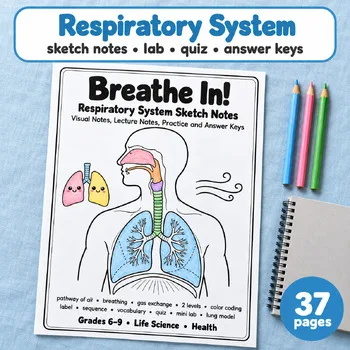
These Respiratory System Notes give grades 6-9 a clear, sketch-note route through the human respiratory system in a 37-page black and white PDF. The notes follow a breath from the nose to the alveoli, so students meet each structure in the order air meets it, not as a list to memorize.
The sketch notes come in four versions to fit different students. Level 1 offers guided notes with a word bank, Level 2 offers guided notes without it, an open version leaves room for students to write in their own words, and a color-coded complete version shows the finished notes. Every version uses the same twelve labels, from the nose and nasal cavity through the pharynx, epiglottis, larynx and trachea to the bronchi, bronchioles, lungs, alveoli, capillaries and diaphragm.
Visual notes carry the ideas that are hardest to picture: how breathing works, gas exchange in the alveoli, how the respiratory and circulatory systems work together, and keeping lungs healthy. Three pages of ready-to-teach lesson scripts, a classroom demonstration, a lung health discussion and discussion questions support the lessons.
Practice keeps the learning active. Students label the respiratory system, follow the pathway of air, put air flow in sequence, match vocabulary, answer a 10-question check and short-answer questions, complete a show what you know activity and finish with exit tickets.
The hands-on work gives students something to measure and build. A breathing rate mini lab includes a data collection table and a results graph, and a build-a-lung model activity lets students see a lung model in action. A 5-day lesson plan, teacher notes, color-coding guide, printing suggestions, classroom uses and safety notes round out the set, and answer keys cover the notes, labeling, vocabulary, checks, exit tickets, lab and model, with sample student responses.
Four sketch-note versions: Level 1 guided notes with a word bank, Level 2 guided notes, an open notes version and color-coded complete notes
Labels for the nose, nasal cavity, pharynx, epiglottis, larynx, trachea, bronchi, bronchioles, lungs, alveoli, capillaries and diaphragm
Visual notes on how breathing works and gas exchange in the alveoli
A visual note on how the respiratory and circulatory systems work together
A visual note on keeping lungs healthy
Practice and checks for understanding
Label the respiratory system and follow the pathway of air
An air flow sequence activity and a vocabulary match
A 10-question check for understanding and short-answer questions
A show what you know activity and exit tickets
Three pages of ready-to-teach lesson scripts with a classroom demonstration and student discussion questions
Hands-on labs and teacher planning
A breathing rate mini lab with a data collection table and a results graph
A build-a-lung model activity
A 5-day lesson plan, teacher notes and a teaching levels and differentiation guide
A color-coding guide, printing suggestions, classroom uses and safety notes
Answer keys for the notes, labeling, vocabulary, checks, exit tickets, lab and lung model, with sample student responses
Ways to use it
Guided notes during a human body systems unit
A sketch-note page in interactive notebooks
Science centers or a test review station
The breathing rate lab in a data and graphing lesson
A build-a-lung model day for hands-on learners
Sub plans built around the notes and practice pages
Why it works
The notes follow one breath in order, so students learn the pathway before they meet gas exchange or the connection to the circulatory system. Four sketch-note versions, a lab with data to graph and a model to build give the same ideas in words, pictures and hands-on work, which helps the sequence stick.
Questions & answers
What grades is it for?
It is written for grades 6–9 and fits biology, life science and health units on the respiratory system, human body systems and gas exchange.
How are the sketch notes differentiated?
There are four versions of the sketch notes: Level 1 guided notes with a word bank, Level 2 guided notes, an open notes version, and color-coded complete notes.
What hands-on work is included?
A breathing rate mini lab with a data collection table and a results graph, plus a build-a-lung model activity.
How do I check understanding?
The set includes a labeling page, a pathway of air activity, an air flow sequence activity, a vocabulary match, a 10-question check for understanding, short-answer questions, a show what you know activity and exit tickets, all with answer keys.
Ready to print Respiratory System Notes?$5.49 · instant PDF download on TPT
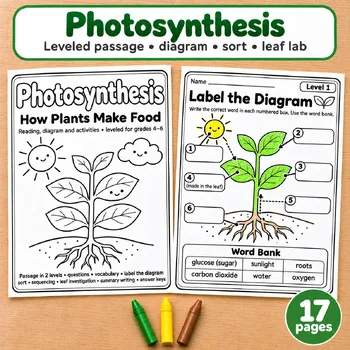
A leveled photosynthesis reading passage for grades 4–6: two reading levels, vocabulary, a labelled diagram, sorting and sequencing, and a leaf investigation.
 🌱
 Created byActivity Express