A student who reads 'was' as 'saw' is not careless. For a dyslexic reader, letters move, lines blur, and a page of print can feel like a wall. The right tool does not remove the wall — it gives the child a way through it, whether that is a phonics programme that teaches the code step by step, an audiobook that keeps them in the class novel, or a colour gradient that stops their eyes from slipping to the wrong line.
This list collects eight tools built for dyslexic students, not general reading apps with an accessibility setting. Every tool here is made for a specific job: structured phonics, audiobooks, reading overlays, or writing support. Some are free for eligible students, some are subscriptions, and two do not publish their prices at all — we say so where that is the case.
We checked every tool on its official website on November 11, 2026, looking for a real fit with K–12 classrooms, clear information about what is free, and features a teacher can set up without an IT ticket. Where a site did not state a price, we say so rather than guessing.
Key takeaways
- Nessy is the most complete programme here: assessment, 100 lessons, and ages 6–11, from $126 a year per child.
- Bookshare is free for qualified US students and schools, with 1.3 million accessible titles.
- Learning Ally's 80,000+ human-narrated audiobooks cost $135 a year for a family membership.
- BeeLine Reader is the cheapest starting point: free on favourite sites, Pro from $2 a month.
- Ghotit and ClaroRead do not publish prices on their sites, so ask for a quote.
Quick comparison
| # | Tool | Best for | Grades / audience | Pricing | Free plan |
|---|---|---|---|---|---|
| 1 | structured phonics games for dyslexic readers | Ages 6–11 | Free + paid | Trial only | |
| 2 | human-narrated audiobooks for school reading | Grades 3–12 | Paid | Not stated | |
| 3 | free accessible ebooks for eligible students | Grades K–12 | Free + paid | Free for eligible students | |
| 4 | spelling and writing support that understands dyslexic spelling | Grades 4–12 | Paid | Trial only | |
| 5 | multi-sensory typing that teaches reading and spelling | Ages 7+ | Paid | 30-day guarantee | |
| 6 | a colour gradient that guides the eyes across lines | Grades 4–12 | Free + paid | Free on favourite sites | |
| 7 | read-aloud with dual-colour highlighting in exams | Grades K–12 | Paid | Not stated | |
| 8 | a personalised intervention after a placement test | Grades K–8 | Paid | Trial only |
Make a tool for teachers?
Built something teachers love? We keep these guides fresh, so send us a new tool, updated pricing or a featured spot request.
Request a listingThe 8 best picks
- Pricing
- Free + paid
- Free plan
- Trial only
- Grades / audience
- Ages 6–11
Nessy Reading & Spelling is a structured literacy programme built for children with dyslexia. A short assessment sets each child's level, then the programme works through 100 lessons across 10 islands, covering phonemic awareness, phonics, fluency, morphology, vocabulary, and comprehension. Lessons are games and videos, and the programme follows a Science of Reading approach to structured synthetic phonics.
What we like
- Assessment that sets each child's starting point
- 100 lessons across 10 islands
- Covers phonemic awareness, phonics, fluency, morphology, vocabulary, and comprehension
- Games and videos with a Science of Reading approach
Watch out for
- Needs adult supervision to keep children on task.
- Works best as part of a wider literacy plan, not on its own.
Pricing: $126 a year per child; school licences from $100 per student a year.
- Pricing
- Paid
- Free plan
- Not stated
- Grades / audience
- Grades 3–12
Learning Ally is a nonprofit that has made audiobooks for students with print disabilities since 1948. Its library holds more than 80,000 human-narrated audiobooks, including the books schools assign, and students listen through an app on iPhone, Android, or the web. A family membership is required, and families must show proof of eligibility.
What we like
- 80,000+ human-narrated audiobooks
- App for iPhone, Android, and the web
- Audiobooks matched to school reading lists
- Run by a nonprofit since 1948
Watch out for
- US only.
- Audiobooks do not replace phonics teaching for a child still learning to decode.
Pricing: Family membership $135 a year; proof of eligibility required.
- Pricing
- Free + paid
- Free plan
- Free for eligible students
- Grades / audience
- Grades K–12
Bookshare is a free accessible ebook library for people with print disabilities, funded by the US Office of Special Education Programs. It holds more than 1.3 million titles, and its free Reader app highlights words karaoke-style as they are read aloud. Qualified US students and schools use it free; others can join with an individual membership.
What we like
- 1.3 million+ accessible titles
- Karaoke-style highlighting that follows the narration
- Free Bookshare Reader app
- Free for qualified US students and schools
Watch out for
- US-focused eligibility.
- The catalogue is ebooks and textbooks, not a phonics programme.
Pricing: Free for qualified US students and schools; individual membership $79.99 a year.
Ghotit Real Writer & Reader
Best for: spelling and writing support that understands dyslexic spelling
- Pricing
- Paid
- Free plan
- Trial only
- Grades / audience
- Grades 4–12
Ghotit Real Writer & Reader is a reading and writing aid built for people with dyslexia and dysgraphia. Its spelling and grammar checker understands the kinds of mistakes dyslexic writers make, including phonetic spellings, and it adds word prediction, a talking dictionary, a screenshot reader, and re-wording help. It runs on Windows and Mac, and the perpetual licence works offline.
What we like
- Spelling checker tuned to dyslexic spelling patterns
- Word prediction and a talking dictionary
- Screenshot reader that reads text from any screen
- Works offline with a perpetual licence
Watch out for
- No Chromebook or Android support.
- Pricing is not published on the site, so contact Ghotit for a quote.
Pricing: Not stated on the official site; a 30-day free trial is available.
Touch-type Read and Spell
Best for: multi-sensory typing that teaches reading and spelling
- Pricing
- Paid
- Free plan
- 30-day guarantee
- Grades / audience
- Ages 7+
Touch-type Read and Spell, known as TTRS, teaches typing, reading, and spelling together through a multi-sensory, Orton-Gillingham based course. Children work through 24 levels of 31 modules each, with dictation exercises that build spelling through sound, and they earn trophies and certificates as they go. Parents and teachers can follow progress on a dashboard.
What we like
- 24 levels with 31 modules each
- Dictation modules that build spelling through sound
- Trophies and certificates for progress
- Parent and teacher dashboards
Watch out for
- Prices are shown as images on the site, so they cannot be copied or read by a screen reader.
- The full course is long, so progress needs regular sessions.
Pricing: Not stated on the official site — prices are shown as images on the pricing page.
BeeLine Reader
Best for: a colour gradient that guides the eyes across lines
- Pricing
- Free + paid
- Free plan
- Free on favourite sites
- Grades / audience
- Grades 4–12
BeeLine Reader colours the text of a page in a gradient that guides the reader's eyes from the end of one line to the start of the next. It works as a browser extension and an iOS app, and it reads websites, ebooks, PDFs, and apps. The free version works on your favourite sites, and Pro adds the full web.
What we like
- Colour gradient that leads the eye from line to line
- Browser extension and iOS app
- Works on websites, ebooks, PDFs, and apps
- Free on your favourite sites
Watch out for
- The free version covers only selected sites.
- The gradient helps some readers a lot and others not at all, so try it first.
Pricing: Free on favourite sites; Pro from $2 a month; education pricing from about $3 per student a year.
- Pricing
- Paid
- Free plan
- Not stated
- Grades / audience
- Grades K–12
ClaroRead is a reading and writing support program from Everway, formerly Claro Software. It reads text aloud with dual-colour highlighting, and its speaking spellchecker catches phonetic misspellings and homophones that a normal checker misses. It also offers word prediction, a speaking dictionary, OCR scanning of printed pages, and an exam edition built for JCQ-compliant tests.
What we like
- Read-aloud with dual-colour highlighting
- Speaking spellchecker for phonetic misspellings and homophones
- Word prediction and a speaking dictionary
- OCR scanning and an exam mode for JCQ-compliant tests
Watch out for
- Pricing is not published, so contact Everway for a quote.
- The exam mode is a separate edition, so check which version you need.
Pricing: Not stated on the official site.
Dyslexia Gold
Best for: a personalised intervention after a placement test
- Pricing
- Paid
- Free plan
- Trial only
- Grades / audience
- Grades K–8
Dyslexia Gold is an online intervention that starts with a placement test, then sets a personalised programme for each child. It teaches phonological awareness and systematic phonics, and its fluency work lets children record themselves reading and listen back. Reading age and speed tests inside the programme track progress, and a single licence gives unlimited access.
What we like
- Placement test that sets a personalised programme
- Phonological awareness and systematic phonics
- Fluency practice with record-and-listen-back
- Reading age and speed tests to track progress
Watch out for
- Progress claims on the site are marketing, so judge it by your own child's tests.
- The price is per month for homeschool, which adds up over a year.
Pricing: Homeschool from $32 a month; US schools from $500 a year for 10 students.
How we chose
We started from tools PreK–6 teachers actually use and checked every one against its official website, pricing page and feature pages on November 11, 2026. We kept tools that fit elementary classrooms, noted whether a free plan exists, and wrote down honest limitations next to the strengths. Nobody paid to be included, and we don't use affiliate links on this page.
- Fit for PreK–6 classrooms, special education or homeschool
- Clear information on the official site about what the tool does and who it is for
- Free plan or free-for-teachers option noted where one exists
- Still active and maintained, with rebrands noted
How to choose the right tool
Start with the barrier, not the tool. If the child cannot decode, pick a phonics programme such as Nessy or Dyslexia Gold. If the child can decode but reads slowly, an audiobook library such as Learning Ally or Bookshare opens up the curriculum.
Check eligibility before you pay. Bookshare is free for qualified US students and schools, and Learning Ally needs proof of a print disability. Both are worth the paperwork.
Try the cheap aids first. BeeLine Reader is free on favourite sites, and a colour gradient costs nothing to test for a week before you commit to a subscription.
Match the tool to the device. Ghotit and ClaroRead run on Windows and Mac, not Chromebooks. Nessy and BeeLine Reader work in a browser, so they fit any device.
Plan for regular short sessions. A phonics programme works when a child uses it little and often, not in one long weekly block. Build it into the daily routine.
Measure progress yourself. Use the reading age and speed tests inside Dyslexia Gold, or your own running records, rather than trusting a tool's marketing claims.
Best pick by situation
- Your student can sound out words but loses their place on the page: BeeLine Reader — the colour gradient leads the eye from one line to the next
- You need a full phonics programme for a dyslexic reader: Nessy — assessment sets the level, then 100 lessons build skills in order
- Your student needs the class novel but cannot read the print: Learning Ally — human-narrated audiobooks matched to school reading
- Your student spells phonetically and a normal spellchecker gives up: Ghotit Real Writer & Reader — its checker is built for dyslexic spelling patterns
- You want a child to practise reading fluency at home: Dyslexia Gold — record-and-listen-back fluency work with progress tests
- You need text read aloud in an exam: ClaroRead — its exam edition is built for JCQ-compliant tests
Pair it with printables
For hands-on decoding practice away from the screen, these Activity Express printables pair with the tools above: decodable passages, an intervention kit, and game boards for K–2.
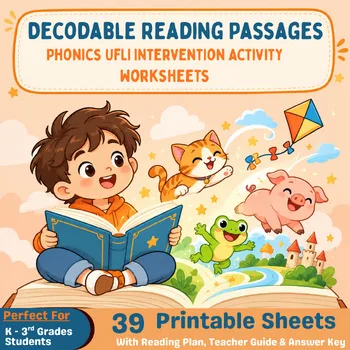 Decodable Fluency PassagesKindergarten, 1st grade, 2nd grade intervention$5.49 · 39 pages
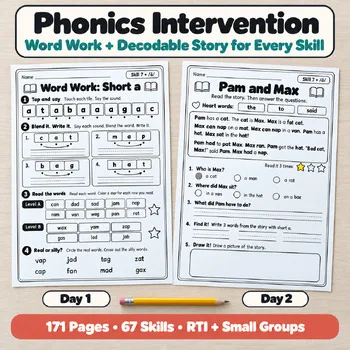 Phonics Rescue Intervention KitKindergarten, 1st grade, 2nd grade$14.49 · 171 pages
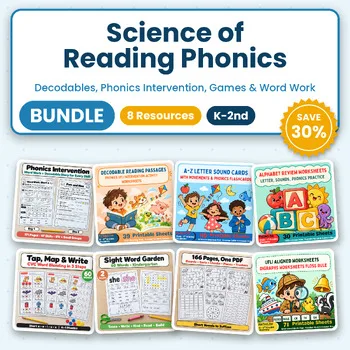 Science of Reading Phonics BundleKindergarten, 1st, 2nd grade$45.49 · 741 pages
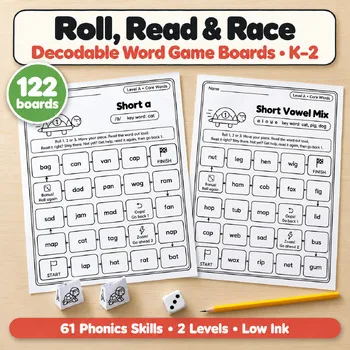 Decodable Phonics Game BoardsKindergarten, 1st grade, 2nd grade$9.99 · 166 pages
Frequently asked questions
Which dyslexia tool is completely free?
Bookshare is free for qualified US students and schools. BeeLine Reader is free on your favourite sites. The rest need a paid plan after a trial, and Nessy offers a 7-day free trial.
What is the best dyslexia tool for phonics?
Nessy Reading & Spelling, because it starts with an assessment, then works through 100 lessons across 10 islands covering phonemic awareness, phonics, fluency, morphology, vocabulary, and comprehension.
Can these tools replace phonics teaching?
No. Audiobooks and reading overlays help a child access text, but only structured phonics programmes such as Nessy and Dyslexia Gold teach decoding. Use access tools and teaching tools together.
What helps a dyslexic student write?
Ghotit Real Writer & Reader, whose spellchecker is built for dyslexic spelling patterns, and Touch-type Read and Spell, which teaches typing, reading, and spelling together.
How much do dyslexia tools cost?
BeeLine Reader Pro starts at $2 a month. Nessy is $126 a year per child. Learning Ally is $135 a year for families. Bookshare is free for eligible students. Ghotit and ClaroRead do not publish prices.
Make a tool for teachers?
Built something teachers love? We keep these guides fresh, so send us a new tool, updated pricing or a featured spot request.
Request a listingDisclosure: no tool on this page paid to be included and we don't earn commissions from these links. Featured placements, if we ever offer them, will be clearly labeled "Sponsored". Details were checked on each provider's official website on November 11, 2026 and can change.