Put one puzzle on the board in the morning and watch what happens. Half the class shouts an answer, the other half shouts that the first half is wrong, and then someone asks for a clue. That argument is the lesson. Logic puzzles do something worksheets rarely do: they make children explain their thinking out loud, test an idea, find it wrong, and try again without feeling punished for it.
The sites below cover the whole range of that work. There is a free problem-solving library from Cambridge, animated riddle lessons with worked solutions, escape-room games for the whole class, a puzzle app built for four-year-olds, free daily number puzzles, and a logic game collection that needs no sign-up. Two paid options close the list, one for classroom escape games and one for older students who want harder puzzles.
How we picked: we checked each tool's official website on November 3, 2026 and only describe features and plans we could see there. We weighted fit for PreK–6 classrooms, whether a teacher can start for free, and whether the puzzles make children reason and explain, rather than just click and guess.
Key takeaways
- Best free starting point: NRICH, with free problem-solving resources for ages 3–18 from the University of Cambridge.
- TED-Ed's free riddle lessons work as a whole-class warm-up, with a worked solution in each video.
- Breakout EDU's Lock of the Day is a 5-minute daily puzzle; the full library starts at $99 a year for one classroom.
- LogicLike covers the youngest puzzlers, ages 4–11, with voiced puzzles for children who cannot read yet.
- Brilliant is the pick for grades 5 and up; Premium is $30 a month for one person or $40 a month for a family of 6, billed annually.
Quick comparison
| # | Tool | Best for | Grades / audience | Pricing | Free plan |
|---|---|---|---|---|---|
| 1 | free classroom problem-solving | Ages 3–18 | Free | Yes | |
| 2 | whole-class riddle lessons | Upper elementary and up | Free | Yes | |
| 3 | escape-room thinking games | K–12 | Paid | Trial only | |
| 4 | young puzzlers, ages 4–11 | Ages 4–11 | Freemium | Yes | |
| 5 | free daily number logic | All ages | Free | Yes | |
| 6 | free logic games, no sign-up | All ages | Free | Yes | |
| 7 | free logic game breaks | Elementary and up | Free | Yes | |
| 8 | logic puzzles, grades 5 and up | Grade 5 and up | Freemium | Yes |
Make a tool for teachers?
Built something teachers love? We keep these guides fresh, so send us a new tool, updated pricing or a featured spot request.
Request a listingThe 8 best picks
- Pricing
- Free
- Free plan
- Yes
- Grades / audience
- Ages 3–18
NRICH is the University of Cambridge's free library of mathematical problem-solving resources, built to help students become more curious, resourceful and confident learners. The problems are curriculum-linked and cover ages 3 to 18, with research-informed teacher support next to the student tasks. For logic and critical thinking, it is the most classroom-ready free option here: the problems ask children to reason their way to an answer instead of recalling a fact, and the teacher notes explain how to run the discussion.
What we like
- Free problem-solving resources for ages 3–18, linked to the curriculum
- Research-informed teacher support alongside the student tasks
- Problems built around reasoning, aimed at curious, resourceful and confident learners
- Run by the Faculty of Mathematics at the University of Cambridge
Watch out for
- The site is math-focused, so pair it with a word-based puzzle site for non-math logic.
- The library runs from age 3 to 18, so pick the age band before you share a link.
Pricing: Free — all NRICH resources are free to use for teachers, students and parents.
- Pricing
- Free
- Free plan
- Yes
- Grades / audience
- Upper elementary and up
TED-Ed is the education arm of TED, built around short animated lessons that teachers can share or customize. Its Riddles Series is the reason it belongs on this list: animated logic puzzles such as Einstein's Riddle, the three gods riddle and the rogue submarine riddle, each with a worked solution that walks through the reasoning step by step. A teacher can play one as a whole-class warm-up, pause before the reveal, and let the class argue about the answer — the discussion is where the thinking happens.
What we like
- Animated riddle lessons with worked solutions, including Einstein's Riddle and the three gods riddle
- A Riddles Series of logic puzzles on the TED-Ed site
- Extra resources to explore on each lesson page
- Teachers can build custom lessons around any TED-Ed animation, TED Talk or YouTube video
Watch out for
- Riddles vary in difficulty, and some suit older students better than younger ones.
- Lessons are videos, so they need a screen and sound.
Pricing: Free — lessons, animations and the riddle series are free on the site.
- Pricing
- Paid
- Free plan
- Trial only
- Grades / audience
- K–12
Breakout EDU turns lessons into escape-room games: students work together to solve puzzles that need them to apply what they have learned, rather than recall it for a quiz. The library holds more than a thousand digital and kit-based games across subjects and grade levels, and the daily Lock of the Day puzzle takes five minutes, so it works as a bell ringer, a brain break or an exit ticket. The site states its games are built to strengthen critical thinking, teamwork and problem-solving alongside content knowledge.
What we like
- 1,000+ digital and kit-based games across subjects and grade levels
- Lock of the Day, a daily 5-minute digital puzzle for bell ringers or exit tickets
- Students solve puzzles together, applying content knowledge in real time
- FERPA and COPPA compliant, with Google Classroom, Canvas, ClassLink and Schoology integrations
Watch out for
- The full library needs a paid subscription after the 14-day trial.
- Some games use physical kits, so check what each game needs before you plan it.
Pricing: Single Classroom starts at $99 a year for one educator and up to 60 students, with a 14-day free trial.
- Pricing
- Freemium
- Free plan
- Yes
- Grades / audience
- Ages 4–11
LogicLike is an online puzzle platform built for children, with more than 4,500 puzzles across 30-plus topics and a dedicated Logic & Thinking course. Puzzles are sorted by age, from 4–6 up to 10–11, and the youngest ones are voiced, so children who cannot read yet can still play on their own. Tasks are short and work on any device, which makes it a good fit for a puzzle station or a few minutes of useful screen time rather than a full lesson.
What we like
- 4,500+ puzzles across 30+ topics, including a Logic & Thinking course
- Puzzles sorted by age, from 4–6 up to 10–11
- Voiced puzzles for children who do not read yet
- Short tasks that work on any device, at the child's own pace
Watch out for
- Full access is a paid subscription, and the price is only shown in the app.
- The site's home page defaults to Russian, so use the English version at logiclike.com/en/.
Pricing: Free to try with some puzzles open; full access is a paid Premium subscription, priced in the app.
- Pricing
- Free
- Free plan
- Yes
- Grades / audience
- All ages
KenKen is a grid puzzle that mixes arithmetic with logic: fill the grid so each row and column holds each number once, while the cages add up to the given totals. The official site lets anyone play free puzzles in the browser in several grid sizes, with Sudoku and 2048 on the same site, and it runs a free classroom program for educators. It is a strong daily routine — one grid on the board each morning, with students explaining how they eliminated each number.
What we like
- Free KenKen grid puzzles in several sizes, playable in the browser
- Sudoku and 2048 on the same site
- A free classroom program for educators
- iOS and Android apps for the whole family
Watch out for
- The site also promotes its apps, so start from the free online puzzles.
- KenKen is number logic, so it practices arithmetic as much as pure logic.
Pricing: Free — puzzles are free to play on the site, and the classroom program is free for educators.
- Pricing
- Free
- Free plan
- Yes
- Grades / audience
- All ages
Brainzilla is a free puzzle site that needs no registration or download. Its Logic Games section holds Einstein's Riddle, Sudoku, Calcudoku, Zebra Puzzles and logic grid puzzles, alongside hundreds of riddles and a Kids Games section with simpler puzzles. The site states its games are free, easy to use and suitable for all ages, and they run on tablets and phones. For a teacher it is a no-friction option: open the page, pick a puzzle, and the class is thinking.
What we like
- Logic games including Einstein's Riddle, Sudoku, Calcudoku and Zebra Puzzles
- Logic Grid puzzles and a Kids Games section
- Hundreds of riddles to solve
- Free to play with no registration or download, on tablets and phones
Watch out for
- The site mixes logic games with word games, solitaire and jigsaws, so link to the Logic Games section, not the homepage.
- Some puzzles are aimed at adults, so preview before assigning to younger students.
Pricing: Free — the games are free to play with no registration.
- Pricing
- Free
- Free plan
- Yes
- Grades / audience
- Elementary and up
Coolmath Games is a free browser game site with a dedicated Logic Games playlist. The playlist's own description says logic games are the ones where players have to take in knowledge and use it to make informed decisions, and it includes Sudoku, Chess, Bloxorz and IQ Ball alongside platforming, drawing and physics puzzles. It is best used in small doses: a ten-minute logic break or an early-finisher choice, with the teacher linking straight to the playlist rather than the homepage, where arcade games dominate.
What we like
- A dedicated Logic Games playlist, including Sudoku, Chess, Bloxorz and IQ Ball
- Detailed instructions for every game on the site
- Free to play in the browser
- Logic games span platformers, drawing, building and physics puzzles
Watch out for
- The site is mostly arcade games, so use the Logic Games playlist link, not the homepage.
- Some games suit older players, so preview before assigning.
Pricing: Free to play on the site.
- Pricing
- Freemium
- Free plan
- Yes
- Grades / audience
- Grade 5 and up
Brilliant teaches math, science and coding through visual, interactive lessons, with a personal AI tutor called Koji that asks guiding questions instead of giving answers. For this list, the draw is its Mind-Bending Math section, which covers puzzles, logic, cryptograms, contest math and combinatorics. The site is built for grade 5 through college and beyond, with adaptive plans and mastery assessments, so it suits upper elementary students who have outgrown simpler puzzle sites — and it is the only tool here that stretches into real contest math.
What we like
- Interactive visual lessons with Koji, a personal AI tutor that asks guiding questions
- A Mind-Bending Math section with puzzles, logic, cryptograms and contest math
- Adaptive plans and mastery assessments that target gaps
- COPPA certified and a kidSAFE member, accredited by ACS WASC
Watch out for
- Built for grade 5 and up, so it is not a match for younger elementary students.
- Full access needs Premium, and the price is shown at checkout and varies by plan.
Pricing: Premium: Individual $30 a month or Family $40 a month for 6 seats, billed as one annual payment; a free tier with limited access is also listed.
How we chose
We started from tools PreK–6 teachers actually use and checked every one against its official website, pricing page and feature pages on November 5, 2026. We kept tools that fit elementary classrooms, noted whether a free plan exists, and wrote down honest limitations next to the strengths. Nobody paid to be included, and we don't use affiliate links on this page.
- Fit for PreK–6 classrooms, special education or homeschool
- Clear information on the official site about what the tool does and who it is for
- Free plan or free-for-teachers option noted where one exists
- Still active and maintained, with rebrands noted
How to choose the right tool
Match the puzzle to the age, not the grade label. LogicLike starts at age 4 with voiced puzzles for children who cannot read yet, while Brilliant starts at grade 5. A puzzle that is too hard teaches nothing except giving up.
Decide whether the screen starts the thinking or is the thinking. The strongest routine is a short digital puzzle to spark an argument, then paper for the working out. A TED-Ed riddle or a daily KenKen works well this way; a whole lesson inside an app does not.
Check the free tier before you plan a unit. NRICH, TED-Ed, KenKen and Brainzilla are free. Breakout EDU gives you 14 free days, then the library costs from $99 a year. Brilliant shows a free tier on its subscribe page, but full access needs Premium.
Use short puzzles as routines, not events. Breakout EDU's Lock of the Day takes five minutes, a KenKen grid fits a morning warm-up, and one TED-Ed riddle a week gives the class a shared puzzle to argue about. Routines build reasoning; one-off puzzle days do not.
Watch for the non-logic content. Coolmath Games and Brainzilla both mix logic games with arcade games, solitaire and jigsaws, so link students to the exact playlist or section rather than the homepage.
Best pick by situation
- You want a free puzzle routine for morning work: NRICH — free problems for ages 3–18 with teacher support
- You want one riddle to open the lesson: TED-Ed — animated riddles with worked solutions
- You want a class escape-room game: Breakout EDU — 1,000+ games plus a daily 5-minute puzzle
- You teach PreK–2 and want logic games: LogicLike — voiced puzzles for ages 4–6
- You want a free daily number puzzle: KenKen — free grid puzzles and a free classroom program
- You want no-sign-up logic games for early finishers: Brainzilla — free logic games, no registration needed
- Your 5th and 6th graders want harder puzzles: Brilliant — logic, cryptograms and contest math from grade 5
Pair it with printables
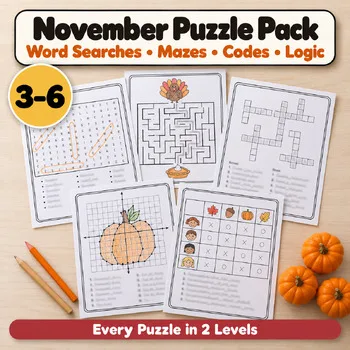
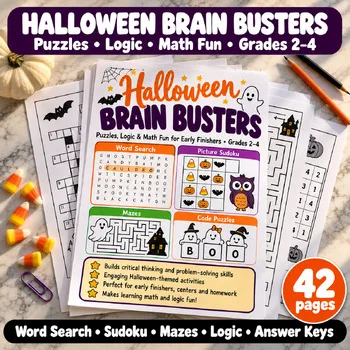
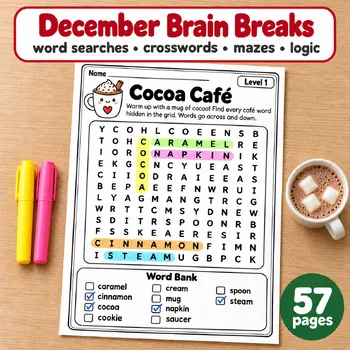
These Activity Express puzzle packs keep the thinking going offline — early-finisher puzzles, word searches and mystery pictures for grades 2–6.
Frequently asked questions
What is the best free logic puzzle site for elementary school?
NRICH is the strongest free starting point. Its problem-solving resources cover ages 3 to 18, cost nothing, and come with teacher support from the University of Cambridge.
Are these sites good for early finishers?
Yes. KenKen, Brainzilla and the Coolmath Games logic playlist all offer short puzzles a student can start and finish in a few minutes, with no account needed.
Can I use TED-Ed riddles without an account?
Watching the riddle lessons is free on the site. Building custom lessons around a video needs a free TED-Ed account.
Do any of these work without a screen?
No, all eight are digital. Use them to start the thinking, then finish on paper — the puzzle printables below are built for exactly that.
Which tool is best for grades 5 and 6?
Brilliant, which starts at grade 5 and adds logic puzzles, cryptograms and contest math. Breakout EDU also suits upper elementary, with games across subjects and grade levels.
Make a tool for teachers?
Built something teachers love? We keep these guides fresh, so send us a new tool, updated pricing or a featured spot request.
Request a listingDisclosure: no tool on this page paid to be included and we don't earn commissions from these links. Featured placements, if we ever offer them, will be clearly labeled "Sponsored". Details were checked on each provider's official website on November 5, 2026 and can change.